Get Full Government Meeting Transcripts, Videos, & Alerts Forever!
Get email alerts on the Fund Balance Policy topic
No spam. Unsubscribe anytime.
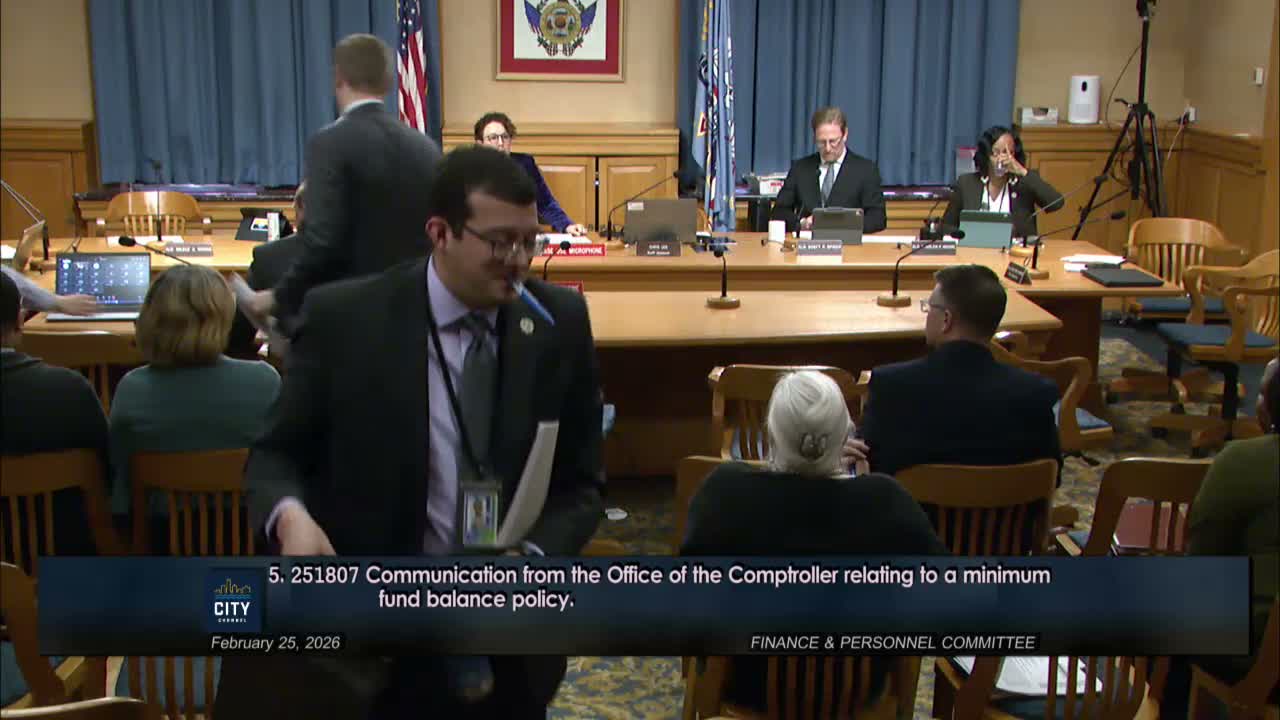
Comptroller urges caution on adopting minimum fund-balance policy, recommends more legal review
Summary
City Controller Bill Christiansen presented two sample fund-balance policies and advised the committee not to adopt either immediately because city ordinances and state statutes (tax stabilization fund and public debt amortization fund) constrain withdrawals and may require legislative changes. The committee placed the report on file.
Bill Christiansen, the city controller, told the Finance & Personnel Committee that adopting a minimum fund-balance policy could strengthen the city’s financial position and its standing with bond rating agencies — but he urged caution.
Christiansen presented two sample policies: Proposal A would set a conservative minimum fund balance equal to 16.7% of general fund revenues (roughly two months of revenues using 2024 figures); Proposal B would set a 10% minimum with a more flexible withdrawal approach. Using audited 2024 numbers, Christiansen said a 16.7% rule would have required the city to find roughly $32.3 million in cuts or added revenue in the 2026 budget because it would have prevented the 2026 tax stabilization fund withdrawal used in that budget cycle.
"I believe it is beneficial for the city to adopt a fund balance policy," Christiansen said, but he recommended delaying adoption until the city examines legal limitations tied to the Tax Stabilization Fund (TSF) and the public debt amortization fund (PDAF), both of which constrain how available balances may be used. He said the PDAF contains historical statutory language dating to the general laws of 1861, and changes could require state-legislative action.
Christiansen suggested exploring whether the city can revise or eliminate the TSF restrictions and whether some restricted funds could be reclassified into unrestricted general fund balance, noting that rating agencies do not treat certain restricted funds as available reserves. He emphasized that adopting a policy only matters if the city adheres to it.
Committee members thanked the comptroller for the analysis and largely agreed with the recommendation to study the legal and practical ramifications before adopting a formal policy. The committee placed the comptroller’s communication on file.