Get Full Government Meeting Transcripts, Videos, & Alerts Forever!
Get email alerts on the Fpc Salary Authority topic
No spam. Unsubscribe anytime.
Finance committee refers pay-range change for police and fire chiefs to full council after heated debate
Summary
The committee debated whether the Fire & Police Commission should retain exclusive authority to place hires within pay ranges or whether the finance chair should also sign off; a proposal to add chair sign-off failed and the substitute salary ordinance was referred to the full Common Council without recommendation.
A Milwaukee Common Council Finance & Personnel Committee debate over who signs off on police and fire chief pay ranges ended with the committee referring the matter to the full council after a contentious exchange.
Alderman Scott Speicher proposed an amendment to the substitute 2026 salary ordinance that would require both the Fire & Police Commission (FPC) and the finance & personnel committee chair to approve recruitment placement within the pay range for the police and fire chief positions. Speicher said the change was intended to preserve the council’s "purse-string" oversight while still allowing the FPC to select chiefs.
The amendment set off a prolonged exchange about institutional independence. Leon Todd, representing the FPC, told the committee that a majority of FPC commissioners supported Alderwoman Charlene Moore’s original amendment and warned that adding council approval risked undermining the FPC’s role as an independent overseer of public-safety leadership. "It allows the council still to set the range authority, or the power of advice and consent in the selection of FPC commissioners," Todd said, and argued the FPC should retain authority to negotiate within reasonable ranges when hiring chiefs.
Opponents of Speicher’s version said it could create procedural delays or effectively give a single council officeholder the power to stall appointments. Chair Alderwoman Marina Dimitrijevich said she found the amendment would create an "ambiguous time frame" and repeated concerns that the committee would be inserted into a negotiation process it does not run.
On a roll call, Speicher’s simple amendment failed (Aye: Speicher; No: Regalis, Dimitrijevich, Moore; one member excused). After further discussion the committee voted to refer the substitute ordinance to the full Common Council without recommendation so the citywide body can take up the text at its March 3 meeting.
The committee’s action does not itself change the salary ordinance; it forwards the substitute ordinance for full-council consideration. Legal staff advised the committee the proposed change appears likely to be lawful but cautioned that language should not be used to indefinitely delay appointments. The chair noted any member could raise amendments during the council debate.
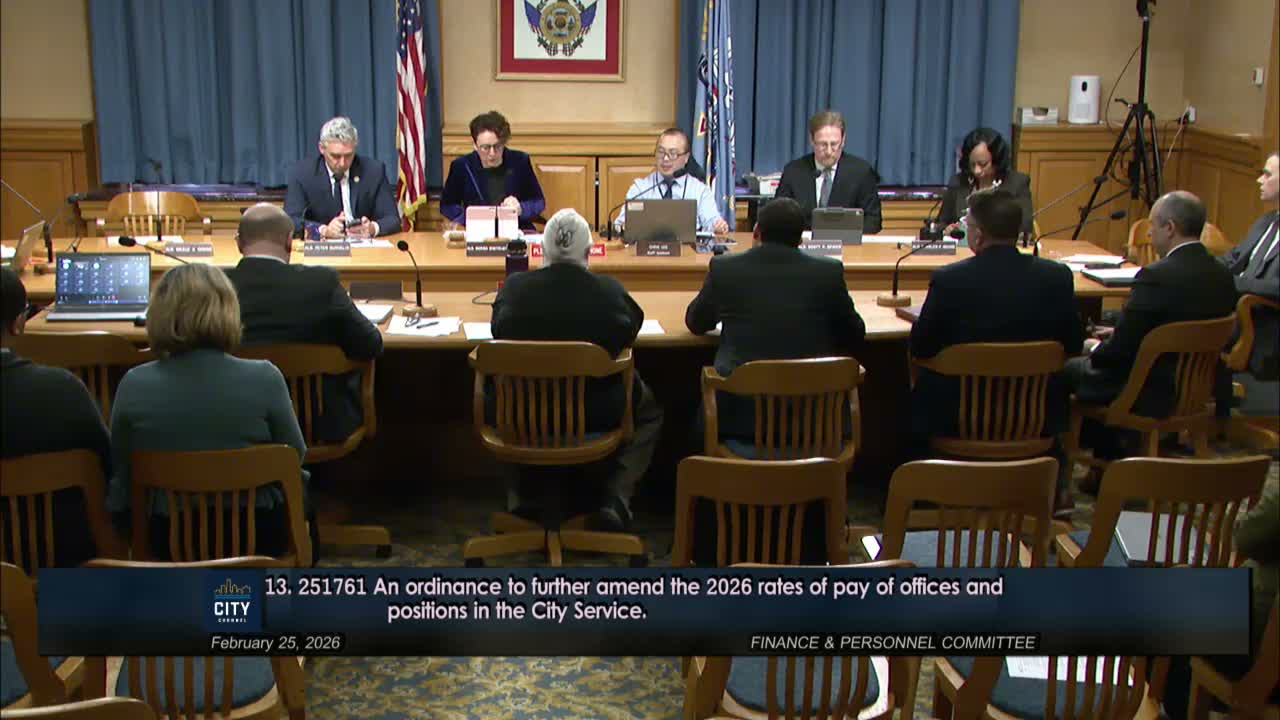
The committee handled the matter as item 13 on its Feb. 25 agenda and agreed to send the ordinance to the full Common Council.