Get Full Government Meeting Transcripts, Videos, & Alerts Forever!
Get email alerts on the Library Policy 6950 topic
No spam. Unsubscribe anytime.
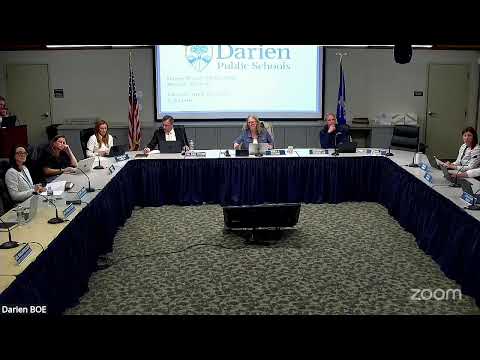
Darien board questions state-mandated library collection policy at first reading
Summary
At a first reading of proposed Policy 6950, Darien board members debated statutory language, definitions of "age-appropriate" materials and review procedures that rely on outside resources; the administration will seek a legal opinion before a second reading.
The Darien Board of Education on April 28 held a first reading of proposed Policy 6950 on library collection development, displays and material reconsideration, and several members raised sharp questions about language the board said is dictated by state statute.
Superintendent Eric Byrne presented the item and said the draft “tracks the statutory language pretty much verbatim” and was revised only slightly after policy-committee review. The policy, he said, is intended to set a transparent process for how library and classroom materials are selected and reviewed.
Board members pressed the administration on practical issues the draft leaves unresolved. One member criticized the statute’s delegation to external review sources, saying that some of the decision-making authority would rest with noncommunity reviewers and asked whether the district could add local parameters. Another board member questioned how the board could inventory existing collections and whether the policy would let the district remove material while it is under review.
“Are we allowed to make any changes?” a board member asked, noting a desire for clarity on whether the policy must be adopted word‑for‑word. Byrne answered that the board would obtain a written legal opinion and invite counsel to the second reading so members could ask threshold and editability questions.
Discussion repeatedly returned to how the policy defines "age‑appropriate" and "grade‑appropriate" content. Administration and policy staff said the policy intentionally references third‑party review resources (for example, Common Sense Media and Kirkus) and that building library media specialists, together with the assistant superintendent for curriculum, would use those tools; when resources disagree, an administrator would make a determination.
Policy staff outlined plans to increase transparency by publishing library and classroom inventories through Destiny (Follett) and to pilot inventory work in upper elementary grades so parents can view titles and raise concerns earlier in the year. The staff presentation said the goal is to balance professional judgment with parent access to information.
Several members voiced distrust after prior controversies over materials. One board member said, in strong language, that state action left the district “handcuffed” and suggested the statute constrains local control; another urged caution in ascribing intent to state lawmakers. A different board member urged respect for library media specialists and cautioned against “pointing fingers” at staff who select materials in good faith.
The administration committed to producing a legal memo before the board’s next meeting and to having counsel present for the second reading so members can ask specific legal and procedural questions.
The first reading concluded with the board agreeing to follow up. No formal vote on policy adoption was taken; the item will return to the board for a second reading after the requested legal guidance.