Get Full Government Meeting Transcripts, Videos, & Alerts Forever!
Get email alerts on the Park Impact Fee topic
No spam. Unsubscribe anytime.
Plan Commission hears amendment to Valparaiso park impact fee, delays vote for clarifications
Summary
The Valparaiso Plan Commission held a public hearing on RES26‑001 to revise housing equivalencies in the city’s recreation impact fee; commissioners asked staff to clarify condominium/unit definitions and carried the item for further refinement and review in April.
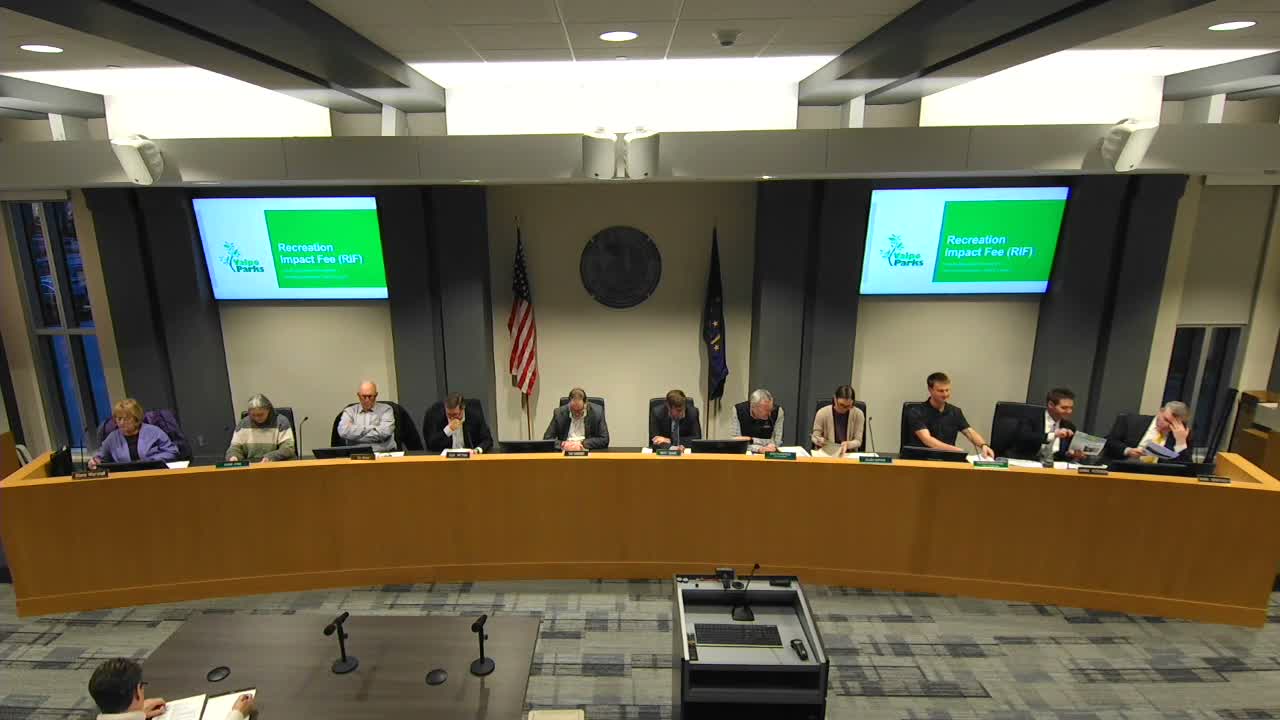
The Valparaiso Plan Commission on March 3 heard a public presentation on RES26‑001, a petition from the Valparaiso Parks Department to amend the recreation impact fee ordinance adopted last year. Tristan (city staff) said the amendment would revise the housing‑equivalency table that determines how much different dwelling types pay the park impact fee.
Tristan said the current ordinance (Ordinance No. 13‑2025) set the recreation impact fee at $2,687 with a 5% annual inflation adjustment and that the new proposal would move townhomes and duplexes to the same equivalency line as condominiums (90%) to align fee application with how units are recorded at the time building permits are issued. “So tonight, we are here requesting approval of the resolution that modifies the housing equivalency portion of the park impact fee amendment,” Tristan said, adding that the change would help the building department consistently apply the fee.
Commission members focused on a technical but consequential point: the ordinance currently uses “condominium” as an ownership descriptor, while building permits more commonly record structure types (for example, duplex or townhome). Commissioner Helen Capitan asked whether the condominium language should be removed to avoid confusion, saying, “Should we just get rid of that language altogether?” Staff and commissioners agreed the ordinance language needs to be clarified so permit reviewers apply the correct equivalency.
A commissioner moved to suspend the rules and vote on the amendment that night to meet a statutory timing concern; the motion failed for lack of a second. Commissioners instructed staff and the petitioner to work with the building department and bring clarified language back at the April meeting so the item could proceed to City Council in time to meet a state deadline for impact‑fee ordinances.
The hearing included a reminder of the statutory framework: Tristan recapped that the Indiana General Assembly’s 1991 impact‑fee statute allows local governments to charge new development a one‑time fee at building‑permit issuance to fund growth‑related infrastructure and requires periodic updates to fee studies. Commission discussion focused on definitional clarity rather than opposing the concept of differential equivalencies.
The commission did not vote on RES26‑001 and will revisit the item after staff and the petitioner revise the equivalency language and confirm permitting practice details. The item remains on the commission’s agenda for April.