Get Full Government Meeting Transcripts, Videos, & Alerts Forever!
Get email alerts on the Tid 5 Infrastructure topic
No spam. Unsubscribe anytime.
Port Washington lays out near-term $100 million city-led projects in TID 5 plan
Summary
City staff and consultants presented an informational plan for Tax Incremental District No. 5 outlining roughly $100 million in near-term city‑led projects (part of about $180 million identified) to extend water and sewer, add looping, and improve treatment-plant resiliency; no formal action was taken.
Port Washington officials and their consultants presented an informational outline of Tax Incremental District (TID) No. 5 project planning, describing near-term water, sewer and resiliency work intended to serve the Vantage development and meet the city’s obligation to serve nearby Canalsville.
The presentation, given by Ben Wood of Strand and Associates and Aaron Grow of Kapoor Engineers and introduced by city staff member Melissa, described a developer‑financed TID with approximately $180 million of identified city‑led projects and about $100 million of near‑term city‑led projects. "Approximately a $100,000,000 of city led projects are anticipated in the next 5 years," Wood said, characterizing that figure as the near‑term forecast of identified needs.
City staff framed the meeting as informational only. "What tonight isn't, it's not an action item. You aren't gonna vote on anything," Melissa told the council, and the team said project decisions will follow the normal public‑works and council review processes.
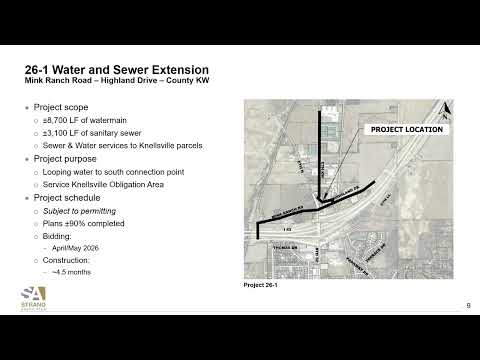
Key project elements and schedule Aaron Grow of Kapoor Engineers outlined the 2026 packages (26‑1 and 26‑2) planned to extend a water‑main loop and sanitary sewer from the water tower near I‑43 north toward Lake Drive and to serve Konellsville parcels and the Canalsville obligation area. Grow summarized scope and timing: "That's both sewer and water: about 9,000 feet of water, 3,000 feet of sanitary sewer," and said plans were about 90 percent complete with bidding expected in May and construction durations of roughly four months per package.
Consultants and staff said permitting discussions with the Public Service Commission (PSC) and Department of Natural Resources (DNR) are underway and that the city will phase work so southern portions are completed before concurrent northern work begins in order to minimize traffic conflicts.
Lift stations and deferred phases Engineers explained that some northern areas will not drain by gravity and will require lift‑station and force‑main work. Those lift‑station projects (for example project 28‑3) have longer equipment lead times and are planned for later phases; consultants estimated some lift‑station work may not be completed until about 2030 to allow for flow analysis and proper sizing.
Treatment plant planning and resiliency The presentation also covered off‑site sewer conveyance, a proposed consolidated booster station to replace older Oakland and Sunset stations (project 27‑1), and proactive facility planning for the wastewater treatment plant. Ben Wood said a facility plan underway will evaluate capacity needs and options — including alternatives that would expand the plant footprint or consider relocating facilities. The plan will also evaluate bluff stabilization and Valley Creek restoration projects (project 27‑5) to protect drinking‑water and wastewater infrastructure; bidding for some bluff‑related work is targeted for 2027 with additional resiliency work slated for 2028–29 as needed.
Canalsville outreach and voluntary connections Council member Miss Miller asked whether homeowners in Canalsville would be required to connect to the new water and sewer lines. "Also, anybody that's in the Canalsville area ... are not gonna be forced to take the water," Miss Miller said; consultants and staff reiterated that connection policy is a matter for municipal leaders and may involve PSC guidance. The town chair has been conducting door‑to‑door outreach to gauge interest, and consultants said project designs include options to serve properties immediately if homeowners choose to connect.
Council concerns and communications During the question‑and‑answer period council members pressed for clearer construction calendars and improved advance notice for closures and detours — including school‑transport coordination with Johnson Bus and notices for the Inner Urban Trail. Melissa clarified that the Inner Urban Trail is owned and operated by the county and that We Energies manages some trail closures, so the city will coordinate links and public information but cannot always unilaterally control trail notices.
What happens next Presenters said permit submissions to PSC and DNR were imminent, bidding for the 2026 packages is expected in May, and the wastewater treatment plant facility plan is expected to be completed by the end of the calendar year. The presentation was posted in the meeting packet and will be made available online with links for public review and comment; no votes or formal actions were taken at the meeting.
The council invited follow‑up questions and requested regular updates, proactive public notices and coordinated construction scheduling as plans proceed.