Get Full Government Meeting Transcripts, Videos, & Alerts Forever!
Get email alerts on the Tax Increment Finance topic
No spam. Unsubscribe anytime.
Redevelopment commission accepts 2025 annual report; warns of TIF sunsets and revenue shifts
Summary
The Valparaiso Redevelopment Commission on March 12 accepted its 2025 annual report showing about $508 million in captured assessed valuation and projected TIF sunsets in coming years that will reduce captured revenue in Washington Township more than corresponding debt-service relief. Commissioners discussed homeowner impacts, overlapping taxing units and next steps to publish details and file required resolutions.
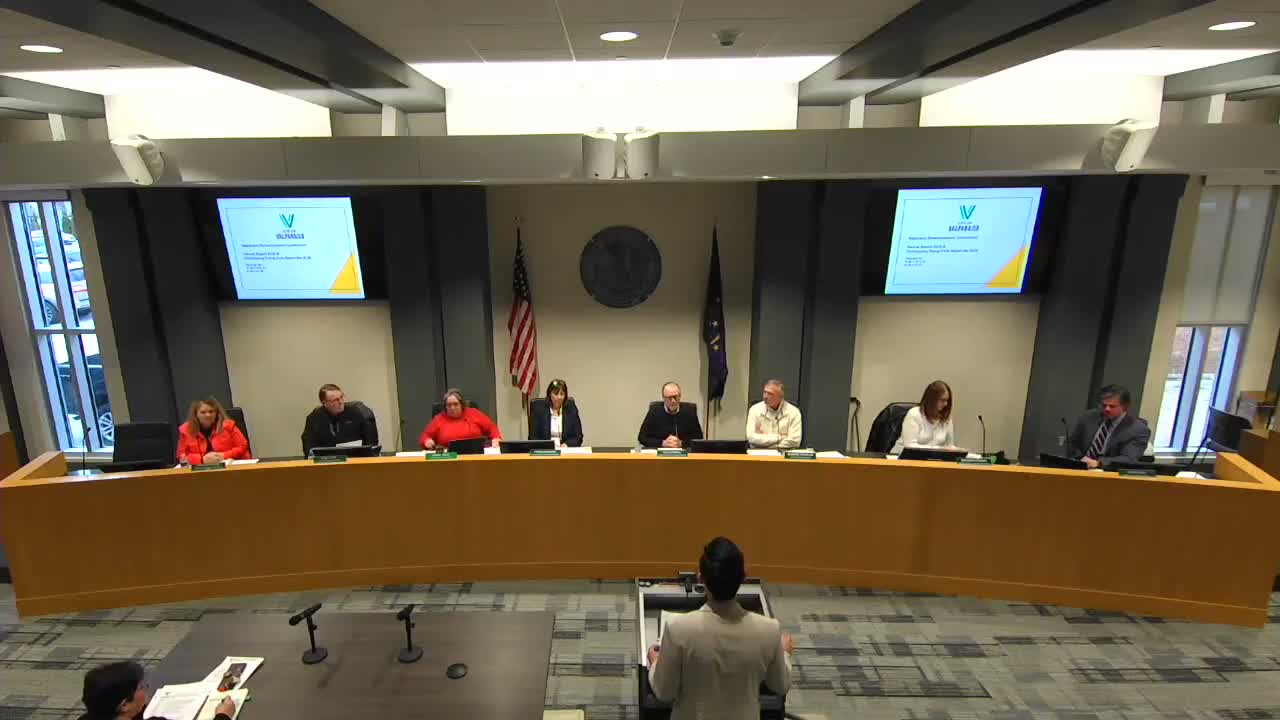
The Valparaiso Redevelopment Commission voted March 12 to accept its 2025 annual report after a presentation by Daniel Dalton of Dalton Municipal Advisors, who told commissioners the city’s allocation areas now represent "about $508,000,000 of assessed valuation," roughly 18% of the city’s total assessed value.
The report showed the commission collected approximately $8.8–$8.9 million in tax-increment revenue in 2025, with most coming from the consolidated allocation area. Dalton and staff walked commissioners through allocation-area sunsets and their timing, noting several districts begin expiring between 2028 and 2031. Staff and commissioners stressed the net effect: debt-service obligations will decline but, in Washington Township alone, staff estimated a roughly $2.6 million projected loss in captured revenue over two years while debt-service relief would be on the order of $1.2 million, producing a net reduction in available funds.
"These areas represent about $508,000,000 of assessed valuation," Dalton said, describing how the consolidated allocation area and individual sections contribute to the commission’s revenue. Commissioners asked for clarification about how much of year‑to‑year growth is reassessment versus new construction, and Dalton explained assessor procedures for identifying new construction and reassessment on property record cards.
President (speaker 2) illustrated the homeowner impact with a worked example and said his personal calculation showed "I paid $74 extra last year as a result of the RDC's indirect activities." George (speaker 4) and other commissioners cautioned that the calculation depends on multiple factors — circuit-breaker caps, levy changes and how much of the captured value flows to rate‑limited funds — and urged the commission to publish an online calculator to help taxpayers understand their bills.
The report also itemized distributions the RDC made back to school districts under the commission’s challenge‑grant program; Dalton and staff reviewed those grants as part of the tax‑impact analysis. Commissioners asked to see more parcel‑by‑parcel detail and staff noted parcel data and prior annual reports will be posted to the state portal and the city’s website; staff also said Baker Tilly is conducting a county‑level parcel analysis that can be used to extract RDC totals.
The commission voted to accept the annual report and directed staff to prepare the statutory resolution on captured assessed value for submission to the county before the June 1 deadline.