Get Full Government Meeting Transcripts, Videos, & Alerts Forever!
Get email alerts on the Redevelopment topic
No spam. Unsubscribe anytime.
Valparaiso redevelopment report: about $8.9 million captured in TIF in 2025; officials outline debt, tax impacts and school grants
Summary
At a city council meeting, Redevelopment Commission staff presented the commissions 2025 annual report, saying tax increment financing (TIF) captured roughly $8.9 million in 2025, reviewed outstanding bonds and described modest estimated tax-rate impacts alongside investments in education.
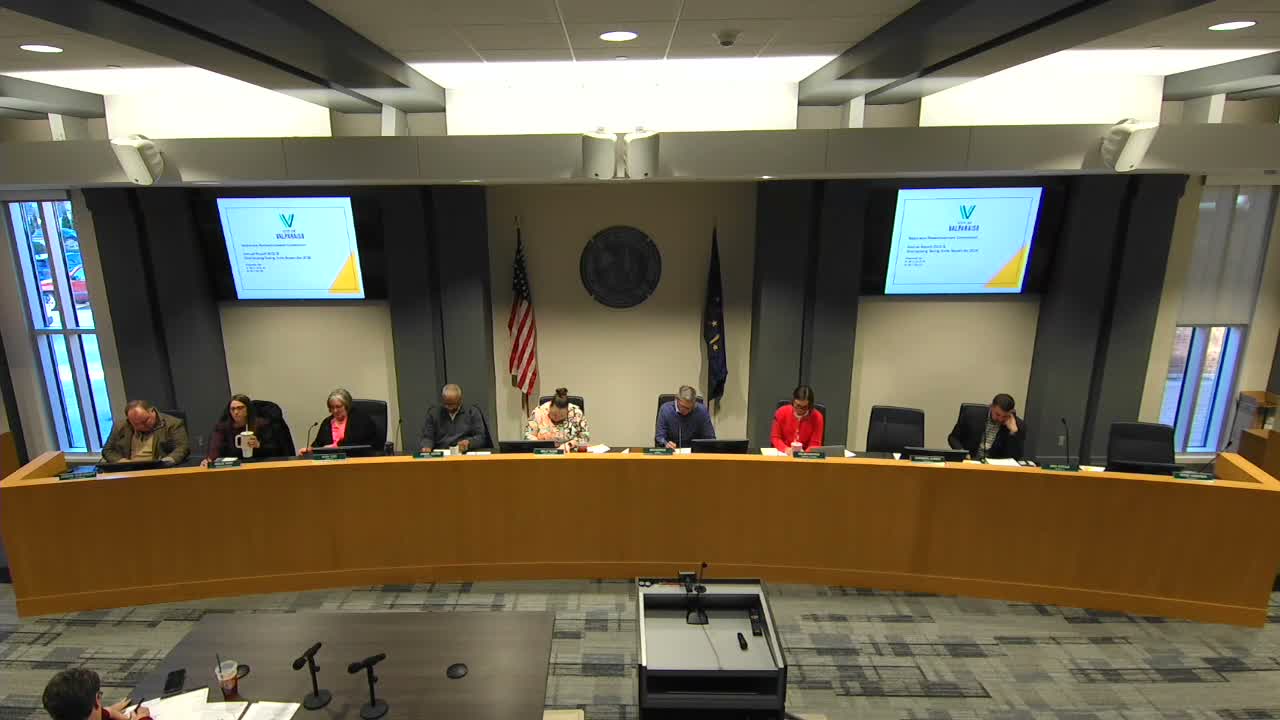
The Valparaiso City Council heard the Valparaiso Redevelopment Commissions 2025 annual report and a financial briefing on the commissions allocation areas and debt obligations.
Daniel Dalton, who presented the financial figures for the commission, told council members that "roughly total 8,900,000 was captured as increment in calendar year 2025." He walked council through required exhibits showing allocation areas (including Vailview, Caulkins Hill, The Link, Journeyman, Grand Gardner and West Street), sunset dates and the commissions debt schedule.
Why it matters: Tax increment financing (TIF) allows allocation areas to retain growth in assessed value to pay redevelopment debt and fund local projects. The presentation sought to show how captured value translates into both project financing and, indirectly, small changes in tax rates for overlapping taxing units.
Dalton summarized commission fund activity, saying beginning fund balances were about $15.0 million on Jan. 1, 2025; revenues for the year were around $15.2 million and expenditures about $14.5 million, leaving an ending fund balance near $15.6 million. He also said the commission invested in local education, citing $226,000 given to East Porter County School through a 21st Century grant and roughly $751,000 distributed among Valparaiso Community Schools, Porter County Career & Technical Education and Porter County Educational Services.
On debt, Dalton listed seven outstanding bonds with varying maturities and interest schedules and explained that some projects use a single allocation areas increment while others rely on consolidated pledges. "If Journeyman does not collect enough incremental revenue in that specific area, the consolidated area will make up the difference," he said, describing how the consolidated allocation area can act as a backup pledge in certain circumstances.
Council members pressed staff on the difference between an "allocation area" and a TIF district (Dalton: they are the same) and on when the consolidated TIF would be tapped. George Douglas, the citys director of development and executive director to the Redevelopment Commission, explained that some obligations (for example, a publicly beneficial garage or transit center) are structured so that a consolidated pledge supports payments if increment in a single area is insufficient. He also said privately placed bonds where the developer is the bondholder shift shortfall risk to the bondholder rather than the consolidated fund.
The presentation included an "impact" exhibit that translates captured assessed value into cents per $100 of assessed valuation for overlapping taxing units; Dalton cautioned those numbers are model estimates that do not directly convert into a single dollar amount for an individual taxpayer without county-level parcel and circuit-breaker calculations. He illustrated an example shown in the materials as a roughly negative $0.129 per $100 of assessed valuation under one exhibit and a roughly negative $0.2409 per $100 for another taxing-district model, noting those are average-model results with important caveats.
The report is available on the citys website through the Redevelopment Commission portal; no formal council action was required on the report itself.