Get Full Government Meeting Transcripts, Videos, & Alerts Forever!
Get email alerts on the Land Use Detention Permit topic
No spam. Unsubscribe anytime.
Glenwood Springs planning commission revokes special-use permit for Midland Avenue detention unit after repeated 12-hour hold violations
Summary
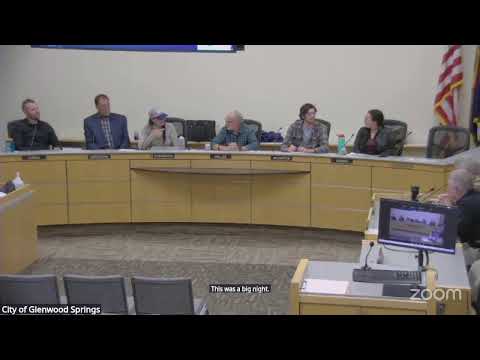
After hours of testimony and more than two dozen public commenters, the Glenwood Springs Planning & Zoning Commission voted 5-1 April 28 to revoke the special-use permit for the Midland Avenue detention suites (planning file 22-03 / SUP 4-04100), citing FOIA-documented exceedances of the SUP's 12-hour maximum hold time.
The Glenwood Springs Planning & Zoning Commission voted 5-1 on April 28 to revoke the special-use permit that has allowed a detention-related use at 100 Midland Avenue (suites 110 and 210), after staff said city records and FOIA-produced documents show multiple exceedances of the permit's 12-hour maximum hold time.
Trent Hyatt of the city's Economic and Community Development staff described the file (planning file 22-03) and said FOIA records and other documents provided to the city show at least 11 instances when the facility held people beyond the permit's 12-hour limit, with documented exceedances in 2022, 2025 and other years. Hyatt told commissioners staff recommends corrective action and offered alternative motions including denial, withholding, revocation or conditional monitoring.
City Attorney Carl Hanlon cautioned the commission that federal supremacy and related federal statutes and regulations limit local enforcement against federal agencies. "An action may not be brought against the federal government, and a fine or penalty may not be imposed against the government for failure to meet the requirements of this section," Hanlon said, summarizing case law and federal provisions. "Essentially meaning that they can ignore us," he added, urging the commission to be clear-eyed about what revocation would accomplish and what it would not.
More than two dozen members of the public addressed the commission during an extended public-comment period. Local attorney Claire Noon said the 12-hour standard separates temporary processing spaces from detention facilities and urged the body to act on the record: "The 12 hour period is not arbitrary," Noon said. Multiple speakers including Ashley Stahl and Marcela Sheflin recounted personal stories and urged revocation, citing life-safety concerns and the building's asserted mismatch with I-3 detention standards.
Commissioners asked staff detailed questions about cell sizes, staffing and the building's certificate-of-occupancy history. Staff reported the space operates as separate male and female holding cells (roughly 10 by 12 feet per cell as estimated during on-site observation), that some building-wide life-safety items were corrected before a full certificate of occupancy was issued, and that some FOIA data are redacted so individual details are limited.
Commissioner Connerton moved to revoke special-use permit 4-04100 (planning file 22-03); Commissioner Houghton seconded. After brief deliberation the commission took a roll-call vote: the motion passed 5-1, with Commissioner Jones voting no. Chair Waller announced the decision and thanked the community for its engagement.
Hanlon and staff said the immediate practical effect is limited by federal law: revocation creates a public record and a formal local position against the use, but might not force operational change by a federal tenant. The decision may be appealed through the city council and to state court, and commissioners acknowledged that separate lawsuits focused on detainee conditions have been the most successful route for altering operations in comparable cases.
The commission moved on to other business after the vote; staff said the record from this hearing and public comments will be part of any follow-up enforcement or appeals process.