Get Full Government Meeting Transcripts, Videos, & Alerts Forever!
Get email alerts on the Project Prioritization topic
No spam. Unsubscribe anytime.
Council narrows Hereford Park baseline to variant 1C, prioritizes animal‑shelter and courts; pond debated
Summary
After choosing Option 1, Rowlett council started a live cost-and-priority exercise and set variant 1C as the working baseline. Members treated animal-shelter needs and courts as high priorities and expressed mixed views about a costly front water feature and ongoing pond maintenance.
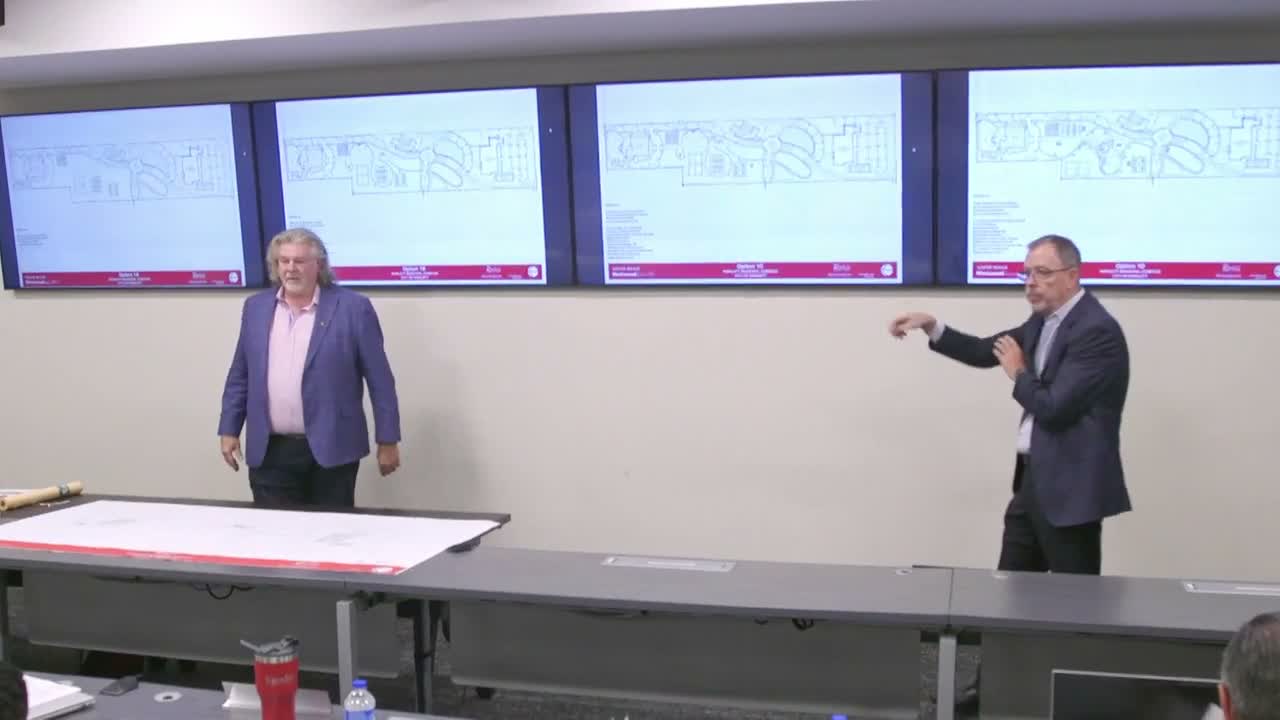
Following its decision to proceed with Option 1, the Rowlett City Council spent the latter part of the evening mapping amenities and ranking priorities against a live cost spreadsheet.
Design staff pulled variant 1C forward as the councils working baseline; several members said 1C offered the best mix of courts, green space, a dog park and smaller play nodes. The design lead explained this would serve as the base configuration that can be edited toward 1B (smaller) or 1D (expanded) as council priorities and budget permit.
Councilors flagged artificial turf and other kennel-area improvements for the animal shelter as nonnegotiable: the council repeatedly described those elements as a top priority. One councilor said the dog‑park pavilion and shade are important given regular user traffic.
A robust exchange focused on water features. The design team described two kinds of pond elements: a reflecting/wet pond at the main entry and a larger retention/detention pond intended for stormwater management. The design engineer explained the larger retention pond would likely be about 8 feet deep and would require an external fill source and additional maintenance if it is kept continuously wet.
The council then reviewed cost lines in real time. The team identified a front water feature priced near $350,000 in the presented worksheet. Using a 1–3 priority scale (1 = high, 3 = low), members distributed rankings across features: animal shelter and courts generally received high priority marks, while the front water feature attracted mixed to lower rankings from several members.
Why it matters: the prioritization exercise translates design preferences into a practical order of construction and contingency use. How the council ranks items will determine what fits inside current funding and what becomes alternate scope.
Next steps: staff will consolidate individual priority rankings, update the cost spreadsheet and return to council with refined renderings, line‑item costs and a recommended order of work.