Get Full Government Meeting Transcripts, Videos, & Alerts Forever!
Get email alerts on the Recode Rowlett topic
No spam. Unsubscribe anytime.
Rowlett officials outline Recode Rowlett plan to simplify zoning and reduce conflicting rules
Summary
City staff told the Planning & Zoning Commission and council the Recode Rowlett initiative will collapse overlapping zoning districts, clarify purpose statements, address tree-preservation conflicts and propose transitional standards, with community meetings and hearings planned before any changes are adopted.
Derek Cole, Rowlett’s director of community development, told the Planning & Zoning Commission and city council on Sept. 30 that the Recode Rowlett effort aims to resolve conflicts between the city’s traditional Rowlett Development Code and a separate form‑based code and to streamline zoning districts.
"We want our developers to have flexibility, but flexibility within a defined toolbox," Cole said, describing the project as a two‑step process of selecting tools and then applying them citywide. He said the committee has reviewed residential and commercial districts and is proposing to consolidate many district types into fewer categories to simplify application and enforcement.
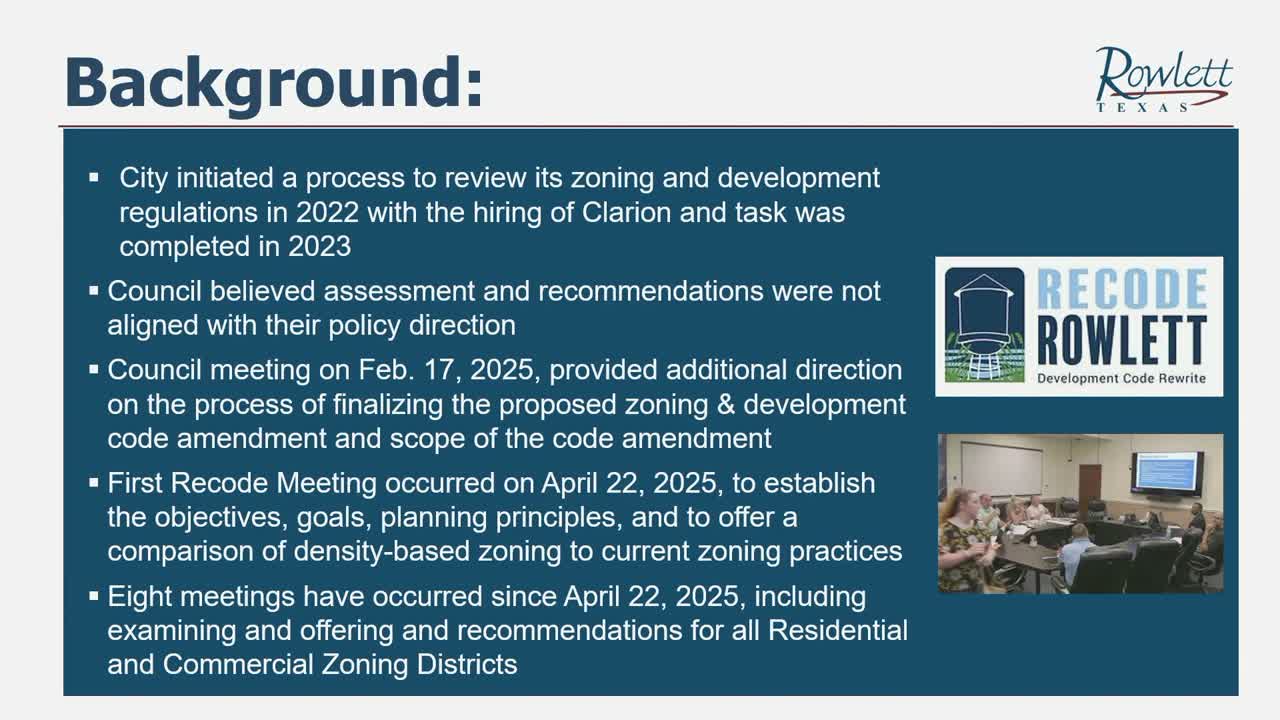
Cole said the committee has met eight times since starting the second edition of Recode Rowlett in April 2025 and has already drafted consolidated purpose statements, design and dimension standards and a plan for zoning‑map analysis. The presentation described the objective to minimize legal nonconforming uses — existing uses that remain lawful but are inconsistent with new rules — and to create transitional‑use standards that reduce conflict between new developments and established properties.
Council and commission members asked for clearer public outreach as the rewrite proceeds. Cole said staff will hold community meetings (required by state law for zoning changes), present to the Planning & Zoning Commission first, then bring final recommendations to city council. He gave a target for finishing the remaining district reviews and associated map work by late October to early November if meetings continue on the current schedule.
The committee will also address areas where the codes conflict, including tree‑preservation rules and the city’s use table, Cole said. He emphasized that the recode is not a comprehensive plan update; it focuses on the zoning ordinance and development regulations.
Next steps: staff will finish remaining district reviews (institutional uses, special use permits and plan developments), complete zoning‑map analysis, post recommended changes, hold community meetings and schedule public hearings at P&Z and council before any ordinance changes are adopted.