Get Full Government Meeting Transcripts, Videos, & Alerts Forever!
Get email alerts on the Exterior Lighting topic
No spam. Unsubscribe anytime.
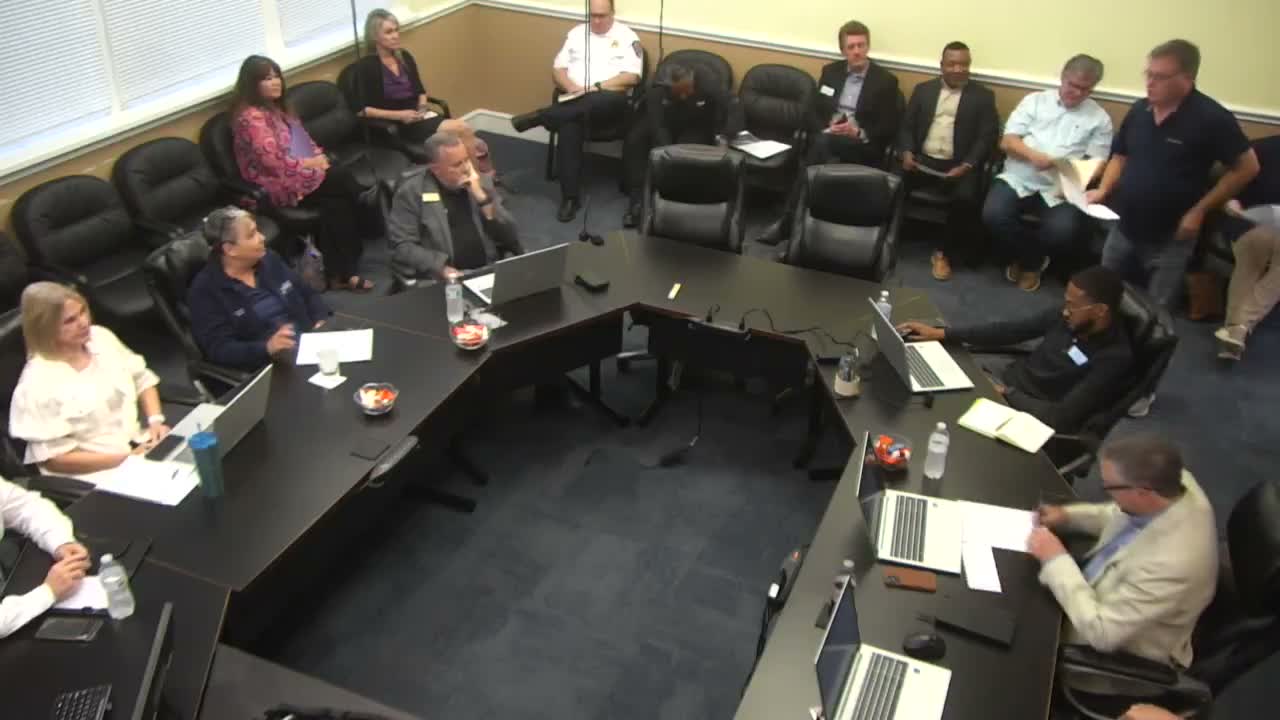
Rowlett council opens discussion on updating exterior‑lighting ordinance
Summary
Council heard three public commenters urging clearer, enforceable outdoor‑lighting rules and asked staff to return with options after comparing neighboring cities' standards. Staff said the current code largely exempts residential uses and lacks numeric foot‑candle guidance.
Mayor (speaker 1) opened the work‑session discussion on possible amendments to Section 77‑5‑10 of the Rowlett Code of Ordinances, saying the staff memo shows Rowlett’s development code is “somewhat silent” on measurable illumination compared with neighboring cities.
Patrick Rowlett, a Rowlett resident, told the council the city's ordinance is "old and outdated," lacks clear definitions for glare and trespass, and is not being enforced. He urged the council to adopt stronger numeric limits—citing peer communities where single‑family limits are 0.25 or lower—and recommended a target of 0.1 foot‑candles and stronger shielding and motion‑sensor requirements.
John Perigi, a resident who spoke next, gave a technical critique of the ordinance's language, noting that the code's 1 foot‑candle example can correspond to many more lumens in common fixtures and is therefore not a protective measurement in practice. "A floodlight produces 700 to 2,000 lumens," Perigi said, and added that the current definition of glare in the code is not quantifiable for enforcement.
Christophe (speaker 4), the staff representative assigned to the discussion, told the council staff's reading of the code is that residential uses are largely exempted and that the ordinance leaves enforcement to broad interpretation. He said staff compiled examples from Garland, Mesquite and Sachse to inform options for Rowlett.
Councilmembers expressed broad support for tightening the ordinance but cautioned against drafting rules that are so prescriptive they become obsolete as technology or fixtures change. "I like the concept of images and guidance, but I worry that calling out a specific fixture may mean only those fixtures are permitted when new ones appear," the mayor said.
Action taken: Council asked staff to return with a range of options (numeric foot‑candle proposals, shielding and angle guidance, and exemptions such as for holiday or temporary lighting) and suggested staff include plain‑language diagrams so residents and enforcement staff can apply rules consistently. No ordinance amendment was adopted at the meeting.
What's next: Staff will prepare options and comparisons to peer ordinances and report back for council direction.