Get Full Government Meeting Transcripts, Videos, & Alerts Forever!
Get email alerts on the Residential Lighting topic
No spam. Unsubscribe anytime.
Rowlett planners review proposed residential lighting code after council asked for 0.25 foot‑candle limit
Summary
City staff presented proposed amendments to Rowlett's outdoor lighting rules, including clearer definitions, measurement methods (photometric plans/cut sheets) and a council‑requested 0.25 foot‑candle limit at property lines; commissioners discussed enforcement, grandfathering and blue‑rich LED concerns.
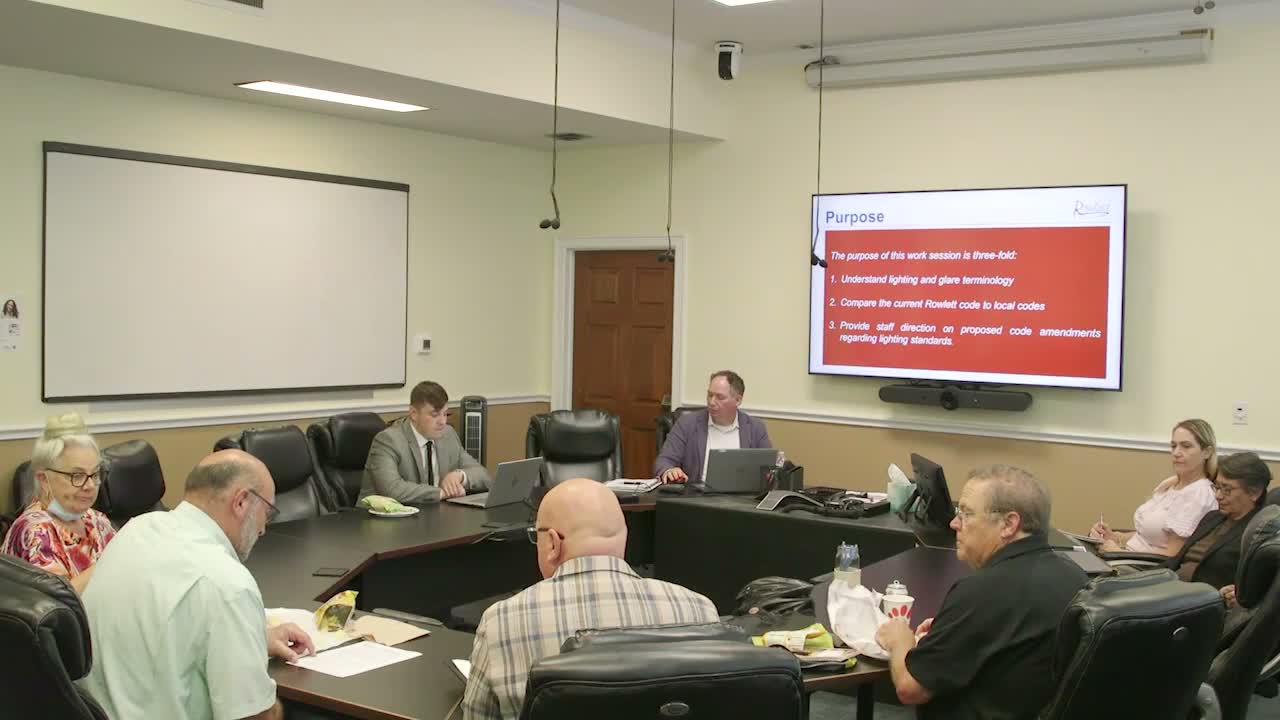
City of Rowlett planning staff on April 14 outlined a draft revision to residential lighting standards aimed at replacing vague, hard‑to‑enforce language with clearer definitions and measurable requirements.
Senior planner Michael King told the Planning and Zoning Commission that City Council asked in January for a measurable limit of 0.25 foot‑candles at the residential property line and for fixtures to be shielded and aimed away from neighbors. King said the change responds to a gap in the current Rowlett Development Code (RDC), which mentions “glare” repeatedly without defining it or providing a consistent compliance method.
King explained photometric terms — candelas, lumens and foot‑candles — and described two enforcement approaches used regionally: pre‑construction engineered computations based on manufacturer photometrics and field luminance measurements after installation. He recommended adding definitions, requiring photometric cut sheets on permit submittals where appropriate, and retaining language to avoid making existing fixtures automatically nonconforming.
The staff presentation compared local approaches. King noted Mesquite and Plano use a 0.25 foot‑candle property‑line standard for residential areas, while Garland’s code offers more detailed design standards and a higher property‑line limit for some uses. King said Plano’s dual method — permitting calculations and field verification — gives both design clarity and post‑installation enforcement tools.
Commissioners asked detailed enforcement questions: whether existing lights would be grandfathered, how security motion‑activated lights and short‑duration fixtures (for example door‑activated lights) would be treated, and whether decorative or seasonal bulbs under 200 lumens would remain exempt. Commissioners also raised public‑health and nuisance concerns about blue‑rich LEDs and the possible sleep impacts of certain color temperatures; staff said color temperature limits and fixture shielding could be addressed in the standards.
King described how enforcement would remain complaint‑driven but rely more on quantitative measurement: code officers would use a light meter in the field and check submitted photometric cut sheets and photometric plans during review. He said the revised approach would enable staff to determine compliance more consistently than the current, highly subjective standard.
The work session did not produce a formal vote; staff will use the commission discussion to refine the draft ordinance and return with language and tables (including illustrative computation tables and specified exemptions) for future action.
Next steps: staff will revise the draft ordinance to incorporate the commission’s feedback on exemptions, event/holiday timing, color temperature and enforcement mechanics, then bring the revised language back to the commission for formal recommendation to council.