Get Full Government Meeting Transcripts, Videos, & Alerts Forever!
Get email alerts on the Special Use Permit topic
No spam. Unsubscribe anytime.
Neighbors press limits as committee hears tavern, live-music permit for 211 Lafayette
Summary
Neighbors opposed a special use permit for a proposed tavern and live-music venue at 211 Lafayette, citing a years-long pattern of noise, trash and code failures; the applicant offered sound-mitigation measures and the committee moved to send the item without recommendation with proposed conditions and a one-year sunset.
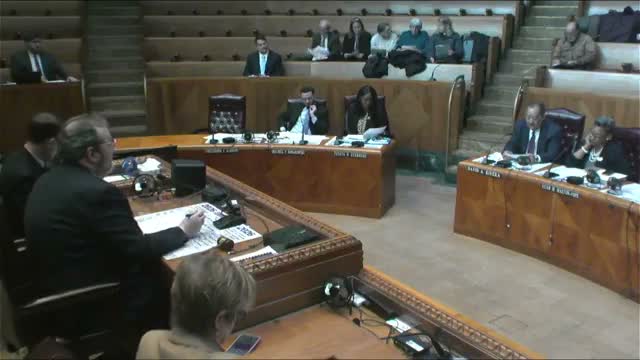
Committee on Legislation members heard extended public testimony April 7 on a special use permit application to reopen a music venue and tavern at 211 Lafayette.
Neighbors Danielle Carlo and Daniel Colleran described a multi-year history of problems with the property under a prior owner, including noise, poor garbage management and what they said were ineffective city inspections. “We had a very difficult relationship with the previous building owner,” Danielle Carlo said, describing children kept awake and a garden where she said she found used needles. Colleran told the committee he and inspectors recorded repeated noise readings “above 110 decibels” and averages “around 85 to 90.”
Applicant Sean Burke and counsel Olivia Mullen said the new operator has reduced onsite speakers and undertaken building repairs. Mullen said she installed two lower-powered speakers and added heavy curtains and sound panels, and that the venue’s design — a former church with natural acoustic projection — requires careful gain control. She said planned live music would be limited, with most events on Friday and Saturday, and said she would work with neighbors on on-site simulations of the sound level.
The committee questioned how enforcement and compliance would work. A member noted ambiguity between police and code-enforcement responsibilities and urged staff to clarify which office would respond to future noise complaints. Committee members and neighbors asked for a simulation of closed-door/closed-window sound levels so neighbors could judge off-site impacts before any license is finalized.
A council member said they would draft standard conditions and suggested a one-year sunset clause so the committee could reassess after a trial period. The public hearing was closed and a motion was made to send the item without recommendation and to record conditions to address sound mitigation, neighbor communication, and a sunset review; the transcript records the motion but does not show a final recorded roll-call vote in the committee.
What happens next: The committee indicated it will draft conditions (including a simulation requirement and communication procedures) and incorporate a one-year sunset if it advances a license; the item will return for further action after those conditions are prepared or at the next scheduled meeting.