Get Full Government Meeting Transcripts, Videos, & Alerts Forever!
Get email alerts on the Higher Education Free Speech topic
No spam. Unsubscribe anytime.
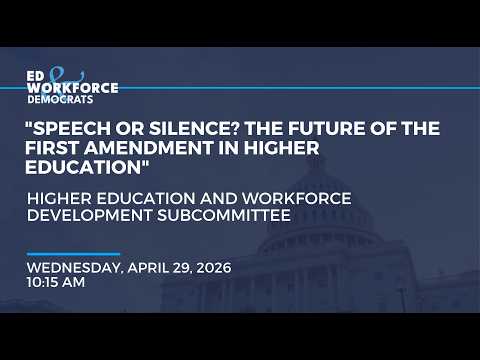
House subcommittee hears competing accounts of campus free‑speech problems
Summary
Witnesses at a House subcommittee hearing offered sharply different diagnoses of campus speech problems: conservative legal groups said universities punish religious and conservative student groups, while civil‑liberties advocates warned against government overreach and curriculum censorship that could stifle research and teaching.
WASHINGTON — A House subcommittee scrutinized how colleges and universities protect — or fail to protect — student free‑speech rights, with witnesses and lawmakers offering competing accounts of whether campuses are the site of a systemic “free speech crisis.”
Tyson Langhofer, senior counsel at the Alliance Defending Freedom, told the panel that public universities frequently adopt policies that censor conservative or religious students, citing examples of speech zones, denial of official recognition for faith‑based groups and no‑contact orders that he said were imposed without due process. "These orders were issued without any due process and without even informing Maggie of the allegations against her," Langhofer said, describing litigation his organization has brought on students' behalf.
The hearing featured three other witnesses who urged restraint in federal intervention. Emerson Sykes, a senior staff attorney at the American Civil Liberties Union, said academic freedom protects inquiry and arguing that the government should not penalize universities for teaching or researching controversial ideas. "The government cannot censor students, instructors, or even visitors just because the government doesn't like the ideas they express," Sykes said, while also noting institutions must comply with civil‑rights laws when speech crosses into harassment.
Judd Horace, president and CEO of the North American Interfraternity Conference, defended Greek life and described policies at institutions such as Harvard and Duke that, he said, single out single‑sex organizations and have pushed chapters off campus. He urged passage of the Freedom of Association Act in Higher Education, which supporters say would require evenhanded treatment of single‑sex student organizations.
Steven McGuire, the Paul and Karen Levy Fellow in Campus Freedom at the American Council of Trustees and Alumni, summarized ACTA’s “gold standard” for campus free expression and survey data showing self‑censorship among students and faculty. McGuire said ACTA’s institutional scores vary widely; he cited the University of Wyoming receiving an 18 out of 20 and the University of North Carolina at Chapel Hill a 20 out of 20 under ACTA’s rubric.
The witnesses anchored their arguments in survey statistics and court cases. Panelists cited figures attributed in testimony to the Foundation for Individual Rights and Expression and ACTA — for example, testimony referenced surveys reporting that roughly 59–65% of students say they self‑censor at least monthly and that 71% reported believing it can be acceptable to shout down a speaker. Panelists debated both the interpretation of those numbers and whether they show a broad crisis.
Lawmakers pressed witnesses on specific claims. Representative Wahlberg, sponsor of the Equal Campus Access Act (H.R. 5505), asked Langhofer how his group has responded when religious organizations were denied recognition; Langhofer described litigation that, he said, changed allocation processes in large public systems so funds are distributed in a viewpoint‑neutral way. Ranking Member Adams warned against congressional mandates that would micromanage academic decisions and emphasized the need to balance free expression with civil‑rights obligations.
Witnesses and members also discussed broader pressures on higher education, including state laws that restrict curriculum content and federal‑level actions and guidance the witnesses said have threatened funding or used investigatory powers to enforce ideological conformity. Sykes said courts have sometimes blocked such measures, but he warned that the cumulative effect of executive orders, compacts and threats to funding can chill research and teaching.
Several members raised concerns about campus safety, allegations of antisemitism, and the treatment of international students who may fear immigration consequences for political speech. Committee members also asked about classroom monitoring and administrative oversight and whether those practices chill faculty speech.
The panel did not take formal votes. The chair kept the hearing record open for 14 days to allow members to submit written statements and materials. Several lawmakers said they would pursue legislation or oversight depending on their priorities: Wahlberg reiterated support for H.R. 5505, and some members said they planned follow‑up on campus practices and federal policy.
The subcommittee adjourned after closing remarks in which members urged nuance, restraint and renewed emphasis on teaching students to debate and think critically. "If we are serious about defending free speech, then we must do so consistently," Ranking Member Adams said, urging evidence‑based approaches that protect both free inquiry and civil‑rights obligations.
The hearing included testimony and exchanges from Tyson Langhofer (Alliance Defending Freedom); Judd Horace (North American Interfraternity Conference); Emerson Sykes (American Civil Liberties Union); and Steven McGuire (American Council of Trustees and Alumni). The record remains open for 14 days for additional submissions, and the committee recessed during a separate House floor vote.