Get Full Government Meeting Transcripts, Videos, & Alerts Forever!
Get email alerts on the Council Procedure topic
No spam. Unsubscribe anytime.
Council defeats proposal to bar unplanned substantive motions until after first round of discussion
Summary
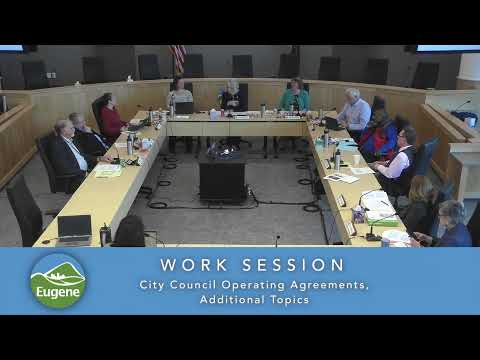
A proposed change to the council operating agreements that would have required unplanned substantive motions to wait until after a full first round of discussion failed 5–3 at the April 27 work session; councilors also debated whether to end randomized speaking order for opponents in quasi‑judicial hearings, but ran out of time.
The Eugene City Council debated proposed changes to its operating agreements at an April 27 work session, including a measure to require that "substantive motions not on the agenda" be introduced only after all councilors had an opportunity to speak in a first round. Councilor Groves moved the change; the motion failed 5–3.
Councilor Groves said the change responds to instances when a motion interrupted questions and prevented other councilors in the queue from weighing in. "We wanted to ask questions. We wanted to understand things. And a motion was made, and once the motion was made and seconded, we could only discuss the motion, not the issue," he said, arguing the rule would preserve members’ ability to fully probe an agenda item before action.
Opponents including Councilor Keating and others argued the proposed rule could contradict Robert’s Rules of Order and limit flexibility. Keating cited Robert’s Rules in saying a "substantive" motion is effectively a main motion and argued that existing rules and procedural tools (motions to postpone, table, or end debate) can address improper use of motions. Several councilors proposed compromises, such as a mayor‑managed queue or a practice that preserves order while still allowing motions in time‑sensitive cases.
The city attorney briefed the council on the distinction between main motions and amendments in the current operating agreements and noted that the existing language already addresses amendment discussion sequencing but does not reach unplanned substantive motions that may be introduced during an agenda discussion.
When the motion was called, the mayor took a voice/hand vote: "3 hands in favor" and "5 opposed," and the motion failed by a 5–3 margin. The council did not record individual yea/nay names in the transcript at the vote.
The second operating agreements topic — eliminating randomization for opponent speakers in quasi‑judicial land use hearings so opponents could organize testimony more like proponents — prompted discussion but was not resolved. Councilor Zelenka argued the current randomized order disadvantages opponents in complicated land‑use matters; the city attorney said quasi‑judicial procedures and time allocations are set in city code and that proponents generally carry the burden of proof, which helps explain different treatment. The council ran out of time and deferred further action on that item.
Councilors did not adopt changes to the operating agreements at this meeting.