Get AI Briefings, Transcripts & Alerts on Local & National Government Meetings — Forever.
Board approves four-unit townhouse plan on Westfield Avenue after detailed review and neighbor input
Loading...
Summary
After extended testimony from the applicant, engineer, planner and architect and questions from neighbors about noise, lighting and traffic, the Clark Township Board of Adjustment approved a plan to build four units at 306–308 Westfield Ave with conditions tied to planner and engineer reports.
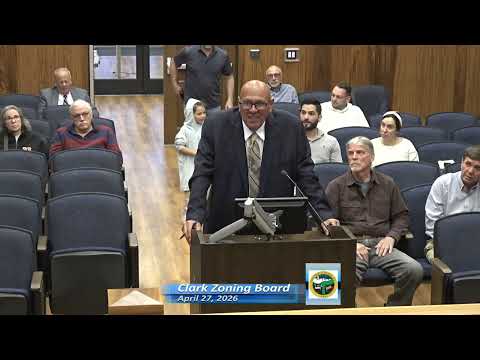
Clark Township — The Clark Township Board of Adjustment voted unanimously April 27 to grant variances allowing a four-unit residential development at 306–308 Westfield Avenue, a project that will consolidate two existing lots and build two, two‑unit buildings on a single tax lot.
Jerry Scaturro, the applicant, testified that he seeks to replace two aging single‑family homes with what his architect described as three‑story, three‑bedroom units intended to provide accessible living; each unit will include a two‑car garage and an elevator to facilitate aging in place. “I’m a long time resident of Clark… I love the town,” Scaturro told the board during his presentation.
The board heard engineering and planning testimony from Anthony Gallerano and architectural testimony from Paolo Dantes. Gallerano said the combined parcel measures 19,954 square feet (about 0.458 acres), noted the site backs up to the Garden State Parkway, and described mitigation measures including an underground detention system for stormwater, a 20‑foot fire‑lane driveway, 19 total parking spaces (four per unit including garage and driveway plus three guest spaces), and new landscaping to screen parking areas. “We felt that splitting the mass into two buildings gives each unit more light and air,” Gallerano said, explaining why the design favors two smaller buildings rather than a single four‑unit block.
Dantes described the buildings’ massing and exterior materials, saying the proposed mean roof height is roughly 33.3 feet (under the 35‑foot ordinance maximum) and that front elevations use gables, dormers, and material changes to reduce perceived bulk. He said each dwelling would have roughly 2,600 square feet of living area distributed over three floors.
Neighbors raised concerns at public comment about noise from the nearby parkway, the visual impact of rear yards that face the highway, lighting color/intensity, sightlines for vehicles exiting the private drive near a curve, and whether a six‑foot fence would be adequate where topography slopes toward the parkway. Robert Cunningham, an adjacent owner, asked for clarity on the lighting scheme and the location of trees to remain; another resident suggested taller sound‑mitigation landscaping because the grade slopes toward the highway.
The applicant’s team agreed to several steps to address neighbor concerns: the landscape plan will favor evergreen screening (arborvitae) along the parkway, lighting will be downward‑directed and designed to zero out at the property line, and the applicant said the homeowners association would be responsible for maintenance (including snow removal) of the private driveway. Counsel for the applicant, Donald B. Frazier Jr., told the board the design ‘‘minimizes negative impact on the neighbors’’ and offered to include reasonable conditions requested by the board.
Board professionals explained the specific variance relief sought: a density variance because the site is slightly under the half‑acre threshold used to compute the by‑right number of units; a side‑yard/ setback variance along the parkway edge in small measure; and a stories variance (the ordinance defines number of stories differently than height). Gallerano argued the deviations were de minimis and that the special reasons and public‑good tests supported relief because the design improves light, air and buffering compared with alternative massings.
After discussion and a final presentation by the applicant’s counsel, a board member moved to approve the application subject to compliance with planning and engineering report conditions and any stipulations agreed on during the hearing. The roll call vote was unanimous; the board’s secretary will prepare a written resolution for memorialization.
The board noted several conditions that will be memorialized in the resolution, including final engineering compliance for grading and drainage, tree‑replacement in accordance with the township ordinance, lighting details that prevent spill onto adjacent properties, and the submission of condominium/master‑deed documentation describing limited common areas and HOA responsibilities. The applicant was instructed to address any outstanding technical comments in the professional memoranda before permits are issued.
The approval concludes the board’s review; next steps are memorialization of the resolution and then submission of final plans to the building department and any county approvals needed for off‑site signage or driveway approaches.