Get Full Government Meeting Transcripts, Videos, & Alerts Forever!
Get email alerts on the Tax Policy topic
No spam. Unsubscribe anytime.
San Patricio court adopts resolution urging state to exempt counties from hotel occupancy tax
Summary
The San Patricio County Commissioners Court unanimously approved a resolution asking the Texas Legislature to exempt counties, county officials and employees from the state hotel occupancy tax when traveling on official business, arguing the exemption would reduce 'tax churn' and lower local taxpayer burden.
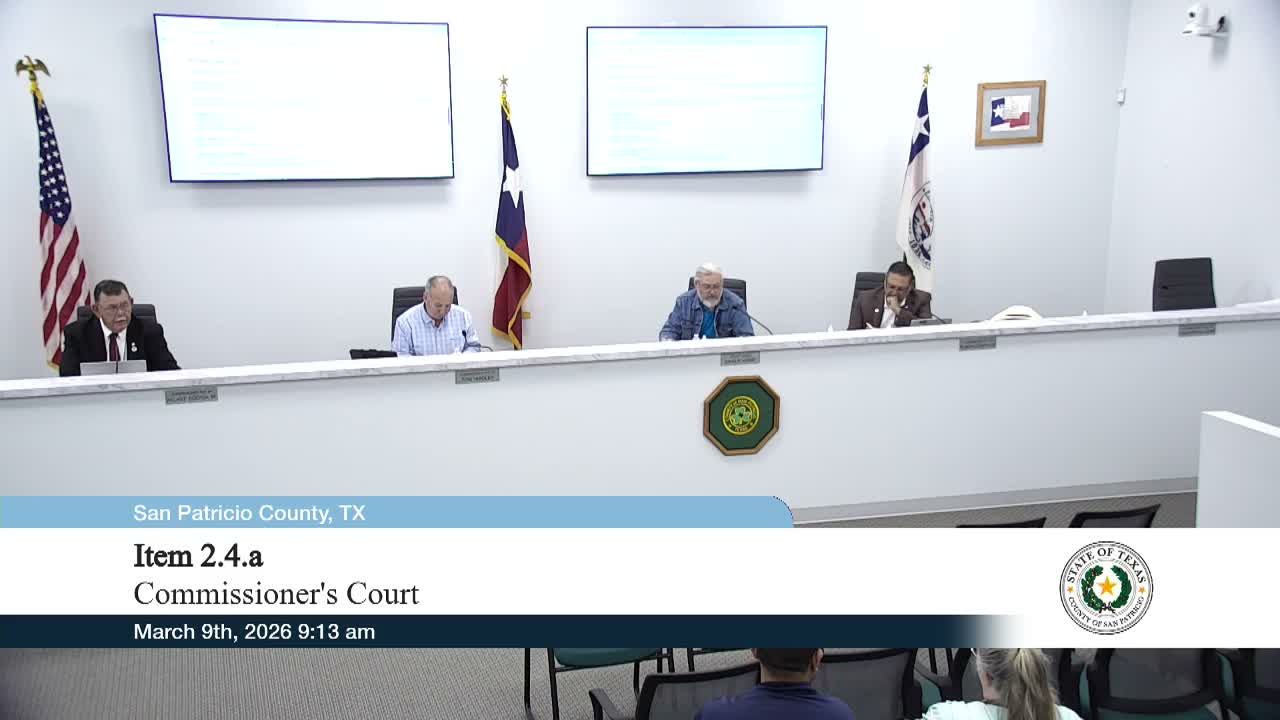
The San Patricio County Commissioners Court voted unanimously to adopt a resolution asking the Texas Legislature to exempt counties, their officials and employees from the state hotel occupancy tax when traveling on official county business. The acting county judge read the resolution aloud, saying the exemption would reduce an "inefficient practice known as tax churn," in which one taxing entity effectively taxes another.
The resolution, introduced for consideration on the court’s agenda, notes that counties provide state-required services and frequently travel for continuing education and official duties that incur hotel charges. It requests that the resolution be forwarded to the county’s legislative delegation and to the Texas Association of Counties for advocacy.
Commissioner Worski moved to approve the measure and Commissioner Yardley seconded; the court approved it by voice vote. The resolution does not itself change county policy or taxes; rather, it expresses the court’s support for state legislation to create the exemption.
The court read the resolution’s findings, which said counties are sometimes required by law to provide services that lead to travel subject to the hotel tax and that exempting counties would align them with other public and nonprofit entities that already receive exemptions. The court directed that a copy be distributed to state legislators and the Texas Association of Counties.