Get Full Government Meeting Transcripts, Videos, & Alerts Forever!
Get email alerts on the Economic Development topic
No spam. Unsubscribe anytime.
Industrial growth plan sparks sharp debate over tax abatements and perceived 'backdoor zoning'
Summary
AECOM economist Chris Brewer presented a San Patricio County industrial growth plan that maps areas suited for large-scale industrial development and recommends using incentive policy to influence siting. Commissioners raised legal and transparency concerns, and a resident urged the court to consult mayors and industry stakeholders.
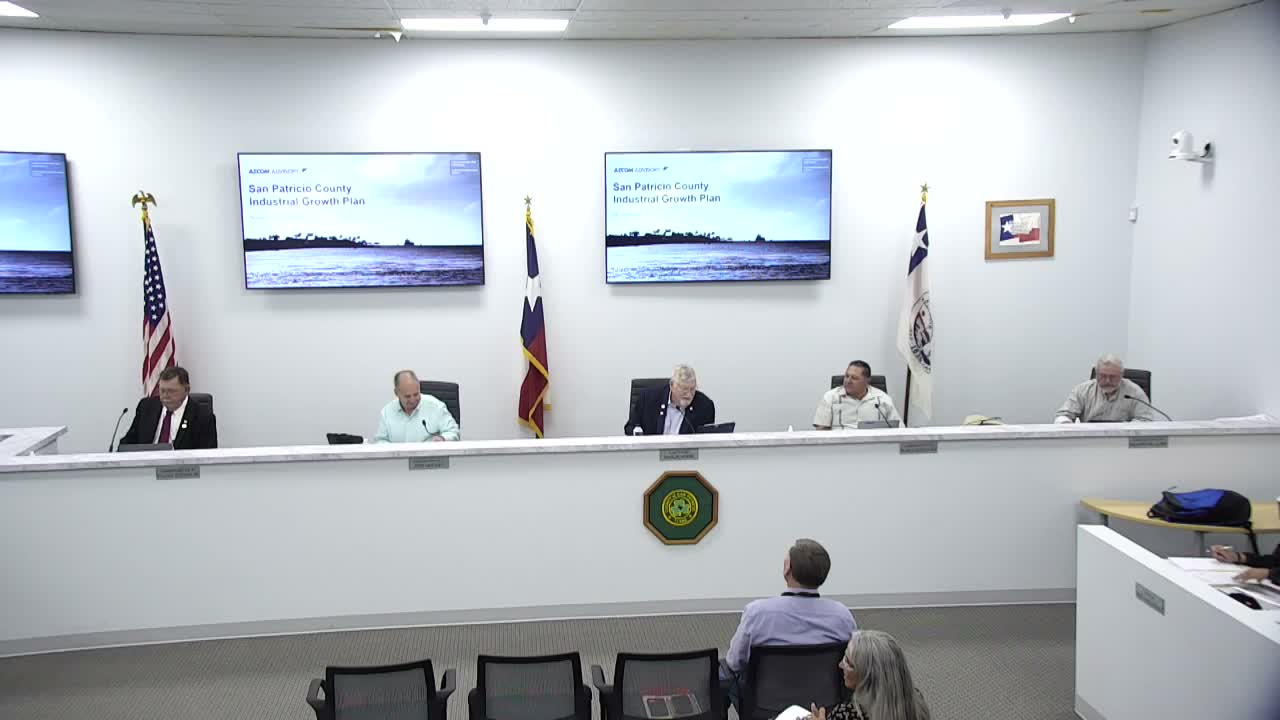
Chris Brewer, an economist with AECOM, presented the county’s industrial growth plan to the San Patricio County Commissioners Court on Nov. 17, describing GIS parcel‑level analysis that identifies places where infrastructure—rail, pipelines, roads and utilities—makes heavy industrial development more likely and more economical.
Brewer said the study focuses on very large industrial uses—facilities that often need hundreds of acres and air permits—and that the work is intended to guide county policy so growth is “intentional.” "We wanted to come at this from a GIS standpoint... to understand places within San Patricio County where the infrastructure is there to support heavy industrial developments," Brewer said.
What the plan recommends: The study maps environmentally sensitive lands, pipeline setbacks, rail access and municipal growth zones and suggests that the county can use its incentives policy—primarily tax abatements—to encourage or discourage heavy industrial siting in particular areas. AECOM estimated roughly 10,000 acres developed in the county since 2017 (about half residential, half industrial) and identified roughly five parcels larger than 500 acres that are likely candidates for heavy industrial projects.
Commissioners pushed back. Commissioner Mason Zukarski called the current rollout "backdoor zoning," arguing that tying incentives to mapped growth zones would devalue some landowners’ property and risk litigation in a state that does not allow county zoning. "When you tie abatements, you're being punitive... That makes a bigger cost when you go to buy that property," Zukarski said, adding that farmers had not been adequately consulted. Commissioner Gillespie and others said the public had received the wrong impression at launch and urged better transparency and clearer city‑by‑city maps of where municipalities do not want industrial growth.
Funding and transparency questions: Several commissioners questioned whether the court had formally approved $150,000 provided by the San Patricio County Economic Development Corporation to support the study; one commissioner said solicitations for funding should come to the full court for approval. AECOM and staff said significant stakeholder engagement had occurred since 2019 and that industry and cities participated in the effort. "The goal of this plan was not to give away land to industry," a county official said, adding that incentives are one tool to guide siting, not to impose zoning.
Public comment: Colette Walls, a resident of the Edroy area who said she had participated in the study discussions, urged the new commissioners to consult mayors and industry partners and noted the plan’s multi‑year history of city engagement.
Next steps: Commissioners asked staff to investigate procedural and transparency concerns and to return with clarifications, including how the $150,000 donation was processed and a map that more clearly shows municipal input. The county did not take a policy vote on the plan during the meeting.