Get Full Government Meeting Transcripts, Videos, & Alerts Forever!
Get email alerts on the Opioids Naloxone topic
No spam. Unsubscribe anytime.
Rep. Frank Tomaszewski proposes bill to require naloxone be offered with certain high‑risk opioid prescriptions
Summary
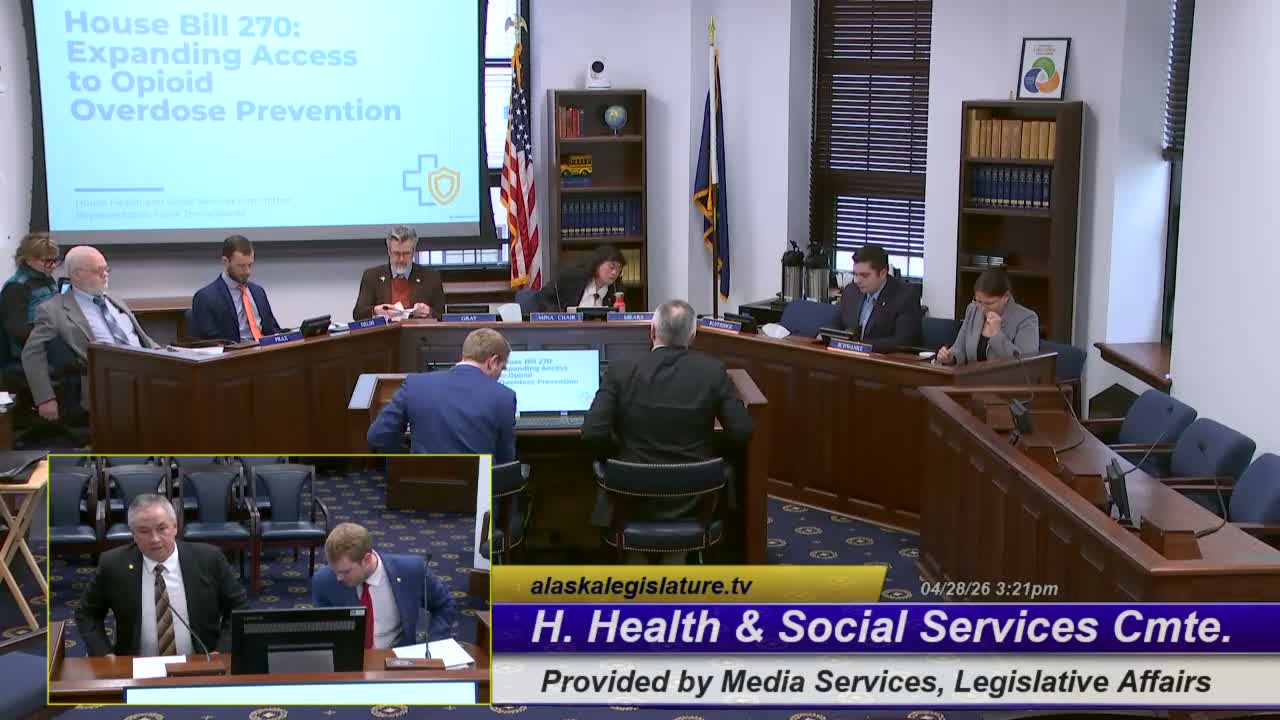
At an April 28 House Health and Social Services Committee hearing, Rep. Frank Tomaszewski introduced HB 270, which would require prescribers to offer a naloxone prescription when one of four risk triggers is met; staff and public witnesses said the measure aims to reduce overdose deaths while preserving patient choice.
April 28, 2026 — Representative Frank Tomaszewski introduced House Bill 270 at a House Health and Social Services Committee meeting in Davis 106, proposing that licensed prescribers offer a prescription for an opioid‑overdose reversal drug such as naloxone when certain clinical risk factors are present.
Tomaszewski told the committee the bill is a "targeted common‑sense public health measure" intended to reduce preventable opioid overdose deaths while preserving appropriate access to pain management. His staff, Connor Mariner, told members HB 270 would require prescribers to offer naloxone when one or more of four triggers apply: (1) the opioid prescription exceeds a three‑day supply; (2) the daily dose is 50 morphine milligram equivalents (MME) or higher; (3) the patient is taking a benzodiazepine concurrently; or (4) the patient has a documented history of overdose or a substance use disorder. The offer would be optional for patients to accept.
The bill’s backers framed the proposal as an evidence‑based mitigation step. "Naloxone is safe, effective and widely recognized as a critical tool in overdose prevention," Mariner said, adding that Alaska recorded 339 overdose deaths in 2024 and that fentanyl accounted for roughly 73% of state overdose fatalities. Mariner estimated total opioid prescriptions in Alaska run about 340,000 to 390,000 per year and said a conservative estimate is that roughly one in three prescriptions would meet at least one trigger — translating to an estimated 100,000 to 120,000 offered naloxone prescriptions annually under the bill’s criteria.
Committee members pressed for details about costs and enforcement. Representative Fields asked how much a naloxone prescription costs at retail; Division of Public Health Director Lindsay Cotto said the division bulk‑purchases naloxone at a separate price and would follow up with pharmacy price information. On enforcement, Mariner said there is no statutory reporting requirement because naloxone is not a controlled substance and would not be tracked in the PDMP; Representative Prox suggested malpractice litigation could create enforcement pressure if a statutory duty were later alleged to have been breached, and Sylvan Robb, director of the Division of Corporations, Business and Professional Licensing, said licensing boards could take action if a provider’s failure to comply with a statutory requirement were reported to them.
Members also asked which provider types the bill covers. Mariner initially listed physicians, advanced practice registered nurses, dentists, and optometrists; licensing director Sylvan Robb explained the measure is intended to cover provider types authorized to prescribe controlled substances in statute and confirmed physician assistants are regulated under AS 08.64.
Two members of the public testified in support. Sandy Snodgrass, CEO of Alaska Fentanyl Response, recounted the 2021 fentanyl death of her 21‑year‑old son and urged passage, saying HB 270 would ensure families receive naloxone and overdose education when opioids are prescribed. "House Bill 270 will change that," Snodgrass said. Stacy Isert of Anchorage described her son’s opioid addiction and fentanyl death and said making naloxone and education available at the point of prescription could prevent future fatalities.
Chair Mina closed public testimony and said HB 270 would be set aside for a future hearing; no final committee vote on HB 270 was taken April 28.
Key details and clarifications discussed at the hearing include Mariner’s data points on 2024 overdose deaths, the bill’s four triggers, the committee’s estimate of potential naloxone offers (about 100,000–120,000 per year under certain assumptions), uncertainty about retail pharmacy costs for naloxone, and that the bill as presented places no PDMP reporting requirement on naloxone offers. Committee staff offered to follow up with more specific counts and pricing information before further action.