Get Full Government Meeting Transcripts, Videos, & Alerts Forever!
Get email alerts on the Criminal Justice Hb 239 topic
No spam. Unsubscribe anytime.
Senate Judiciary Committee adopts revised substitute for House Bill 239; Department of Law flags constitutional limits on generated-image prosecutions
Summary
The Senate Judiciary Committee adopted work draft H for House Bill 239, which revises several criminal statutes — including new provisions targeting generated child sexual-abuse images and tightened failure-to-render-aid penalties — and moved the bill to finance; Department of Law staff explained implementation constraints under Ashcroft v. Free Speech Coalition and the Miller obscenity test.
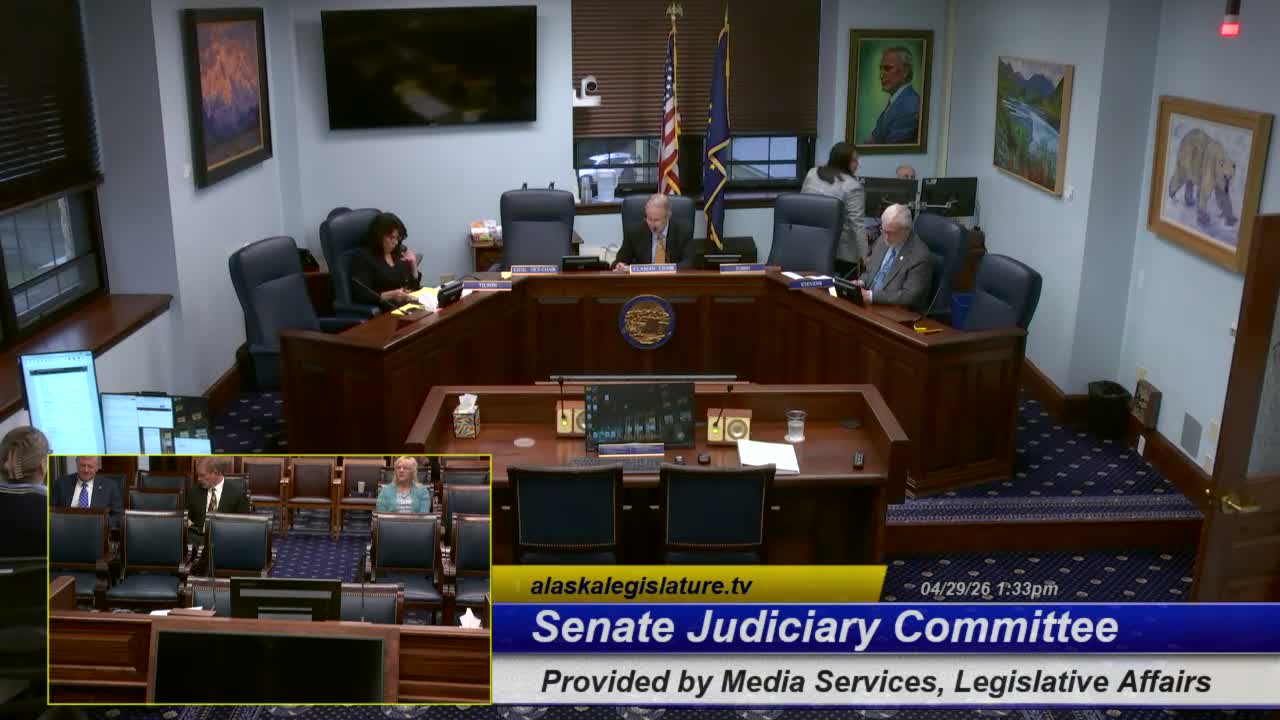
The Alaska Senate Judiciary Committee on April 29 adopted a revised committee substitute (work draft H) for House Bill 239 and moved the measure out of committee to the Finance Committee.
Chair Senator Matt Klayman convened the committee and said the substitute, the product of work by the sponsor, committee staff and the executive branch, was intended to correct drafting errors and close gaps in existing criminal statutes. "This committee substitute has been the product of collaboration between the sponsors office, committee members, my office and the executive branch," Klayman said as the panel adopted version H as its working document.
The substitute makes a range of changes across Alaska Statutes. Committee aide Brianna Kekaruk summarized edits to provisions addressing enticement of a minor (AS 11.41.452), solicitation or production of indecent images of a minor (AS 11.61.124), and distribution of indecent material to minors (AS 11.61.128); deletion of earlier mail-theft language proposed in version G; added language criminalizing possession of images involving animal cruelty in certain sections; amendments to felony sentencing sections; and the insertion of a new statutory subsection creating medical-release authority for electronic monitoring. Kekaruk also said the bill’s immediate-effective dates were replaced with a uniform effective date of July 1, 2026.
The Department of Law provided a targeted legal briefing on section 24, which addresses generated child sexual-abuse material. "Ashcroft v. Free Speech Coalition said that child [sexual-abuse] material involving the use of real children is not protected by the First Amendment categorically," Casey Schroeder, senior assistant attorney general (criminal division), told the committee. Schroeder explained that virtual or computer-generated images may be protected unless they meet the Miller obscenity test, which the draft retains. "If we can't prove whether a real child was used . . . the generated-child provisions provide a tool for us to use and then we would prove that it was also obscene," Schroeder said, summarizing the department's rationale for the change.
Senator Stevens asked the department to contrast the new draft with existing law. Schroeder said current statutes already criminalize material that uses real children and that some courts have treated "morphed" images as unprotected; the new language is intended to give prosecutors an avenue to address high-quality, fully generated images that are difficult to distinguish from images of real children, subject to the obscenity standard.
On sections 62–64, Schroeder described an expansion of the failure-to-render-aid (hit-and-run) statute. The revised text creates an elevated penalty where a driver leaves the scene and a person later dies; the statute requires only that the defendant knew or reasonably should have known an accident had occurred such that someone might be injured — it does not require a mental state as to the later death. "That it is a very limited scope for this particular provision," Schroeder said, adding that the change would at minimum elevate the presumptive sentencing range for such conduct.
After the department’s remarks and a brief exchange with committee members, Chair Klayman withdrew his earlier procedural objection and, with no further objections, the committee adopted version H as the working document. Representative Kopp, the House sponsor, thanked the committee and said the changes close known loopholes and add prosecutorial tools. "Some of it which is uncomfortable to discuss in committee hearings but we know that it is driving a lot of our behavioral and mental issues," Kopp said.
Senator Tobin moved the senate committee substitute out of the Judiciary Committee; the chair announced there were no objections and that House Bill 239 would proceed to the Finance Committee. The committee adjourned at 2:46 p.m.; members were reminded that the next meeting, set for May 1 at 1:30 p.m., will include a confirmation hearing for the attorney-general nominee Steven Cox and consideration of Senate Bill 207.
What’s next: HB 239 will be scheduled for the Finance Committee’s review; the bill’s July 1, 2026 effective date was retained in the adopted draft. The committee record notes the Department of Law will be available to address further implementation questions as the bill advances.