Get AI Briefings, Transcripts & Alerts on Local & National Government Meetings — Forever.
Bill to ban disposable polystyrene food containers receives committee hearing and pro-environment testimony
Summary
Representative Andy Josephson presented HB25 to prohibit expanded polystyrene (EPS) food service ware for restaurants and state food operations; supporters—including Alaska Community Action on Toxics—testified on health and environmental harms, and DEC said it would provide guidance for implementation and hardship exceptions.
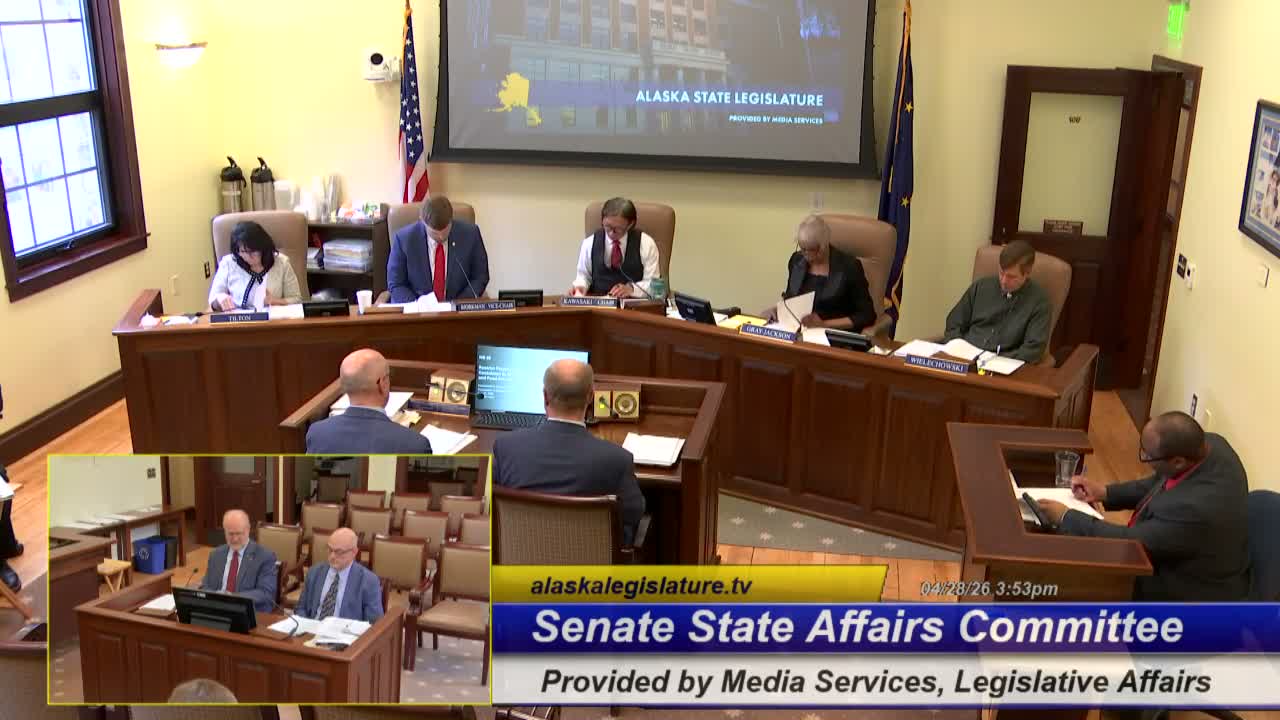
Representative Andy Josephson told the Senate State Affairs Committee that House Bill 25 would prohibit disposable expanded polystyrene (EPS) food-service containers used by restaurants and food-service operations in the State of Alaska.
Josephson said EPS cannot be recycled at scale and presents environmental hazards when it fragments into microplastics. He also described health concerns raised by clinicians and cited supporting letters from groups such as Oceana. The sponsor said the bill is focused on restaurants and similar food-service operations and would allow other plastic alternatives and reusable options.
Ken Alper, staff to Rep. Josephson, summarized key provisions: the prohibition would include state food operations (for example, Marine Highway services and some correctional facilities), allow DEC to accept hardship applications, and exclude reusable products and most packaged food that originates out of state. The bill delays take effect to the stated effective date to allow businesses time to transition.
Pamela Miller, executive director and senior scientist at Alaska Community Action on Toxics, testified in support. She told the committee that polystyrene contains styrene, which she described as a hazardous monomer that can leach into hot, acidic or fatty foods and that EPS persists as environmental pollution and fragments to micro‑ and nano‑plastics. She pointed to municipal ordinances in Bethel, Cordova and Seward and said businesses and suppliers (including Green Alaska Solutions) are offering plant‑based alternatives.
Committee members asked about enforcement and costs. Sponsor and staff said enforcement would be through DEC’s routine food-safety inspections, with warnings for first violations and a $200 fine on a later violation as described in the bill’s penalty table. DEC’s environmental health division director, Sandy Perry, said the agency would likely issue guidance on practical measures such as "bring your own container" and would look to other states' implementations rather than promulgate new regulations.
Multiple committee members raised supply-chain and fiscal concerns; staff said the bill includes a transition allowing restaurants to use stock they purchase by Dec. 31 before the ban takes effect in order to avoid sudden supply disruptions. Supporters described alternatives priced competitively, and the sponsor said the bill enjoyed bipartisan support in the House.
The committee took no vote and set HB25 aside for later consideration.