Get Full Government Meeting Transcripts, Videos, & Alerts Forever!
Get email alerts on the Healthcare Affordability topic
No spam. Unsubscribe anytime.
Expert outlines state tools to rein in rising commercial health‑care costs
Summary
Michael Baylitt told the Senate Health and Social Services Committee on April 28 that states are using measurement, price caps, growth caps, site‑neutral payments, and competition policies to address runaway hospital and drug pricing; Rhode Island, Oregon, Indiana and Colorado were cited as examples with mixed evidence and open questions about access and enforcement.
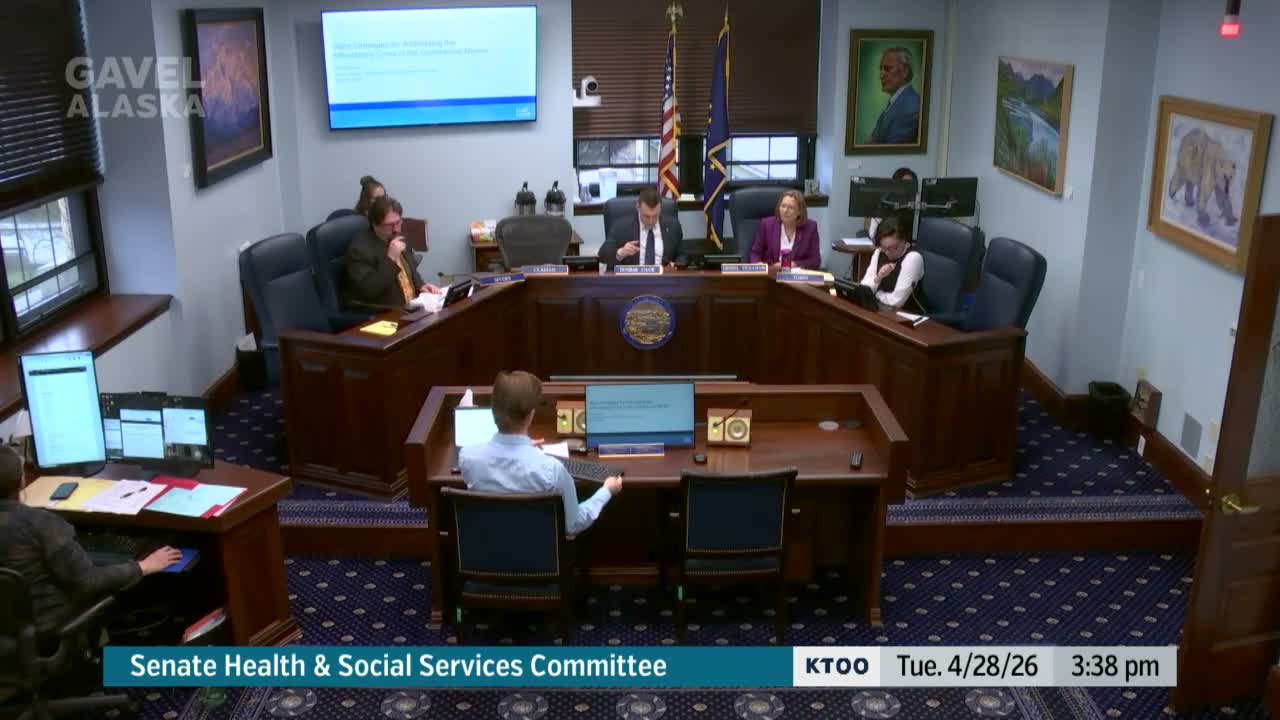
Michael Baylitt, introduced to the Senate Health and Social Services Committee on April 28, gave an overview of state‑level strategies aimed at improving commercial health‑care affordability and the evidence behind them.
Baylitt told the committee that rising commercial health costs are altering consumer behavior: "Over a third of adults report that they are skipping or postponing health care that they think that they need solely due to cost," and "about 20% aren't filling prescriptions." He said hospital and prescription drug spending are major drivers of premium growth, and many states are focusing policy efforts there.
Baylitt reviewed several categories of state action:
• Measurement and transparency: States such as Rhode Island and Minnesota have built all‑payer databases, targets, or centers for health‑care affordability that convene insurers, providers and consumer advocates to measure spending growth and develop collaborative strategies. Baylitt highlighted Rhode Island’s OHIC dashboards and compact approach.
• Price caps and reference pricing: Several states cap payments relative to Medicare (for example, Oregon’s 200% of Medicare cap applied in public/employer plans). Baylitt described three implementation levers — state purchasing authority, insurance regulation of the fully insured market, and direct provider price regulation — and noted states vary in scope and exemptions for rural/small hospitals.
• State examples and evidence: Baylitt cited Indiana’s approach using nonprofit status levers to influence large systems, New Mexico’s caps (200% of Medicare in‑network, 175% out‑of‑network in some urban areas), and Oregon’s long‑running program. He said Oregon’s first two years saved roughly $108 million (about 4% of planned spending) and that a Brown University analysis found no evidence hospitals left the state employee plan networks or raised commercial prices in the markets that study covered.
• Drug pricing tools: Baylitt described prescription drug affordability boards and upper payment limits, noting Colorado set a $31,000 annual cap for Enbrel (average price exceeding $50,000) and has so far withstood court challenges. He cautioned that drug‑cap policies are newer and long‑term effects remain uncertain.
• Site‑neutral payments, facility fee bans and growth caps: These tools align hospital reimbursement with community settings, prohibit certain facility charges, or cap price growth (Rhode Island ties growth to CPI+1%); Baylitt pointed to evaluations suggesting meaningful savings in some cases but said states must weigh tradeoffs for access and provider financial stability.
Committee members pressed policy and implementation details. Senators asked whether price caps can prompt hospitals to sell or close services and whether small states like Alaska are at particular risk of losing specialty capacity. Baylitt said Rhode Island experienced one hospital closure since implementing caps but had not seen widespread bankruptcies, and he acknowledged the evidence base is still developing. Laurie Wing Hyer, the legislature’s health care liaison, told senators that Alaska’s geography and small population magnify access risks and that hospital acquisitions are producing facility fees in some local markets.
Baylitt provided resources for further review, including a state hub for hospital pricing strategies, the Peterson‑Milbank program, and a Healthcare Affordability Lab at Yale. The committee closed the presentation, reminded members of other amendment deadlines and adjourned at 04:41.
What to watch: lawmakers may weigh whether to pursue measurement/information tools, insurer‑side levers, or statutory price limits — each approach presents tradeoffs in enforcement complexity and potential access impacts, particularly for a geographically large, low‑population state such as Alaska.