Get AI Briefings, Transcripts & Alerts on Local & National Government Meetings — Forever.
Alaska panel hears bill to tighten disclosure for out‑of‑state campaign money
Loading...
Summary
Rep. Kevin McCabe introduced HB 371 to expand disclosure for independent expenditures and require in‑state presence or registered agents for groups primarily funded from outside Alaska; committee members pressed for clearer definitions, enforcement capacity at APOC and election‑cycle accounting.
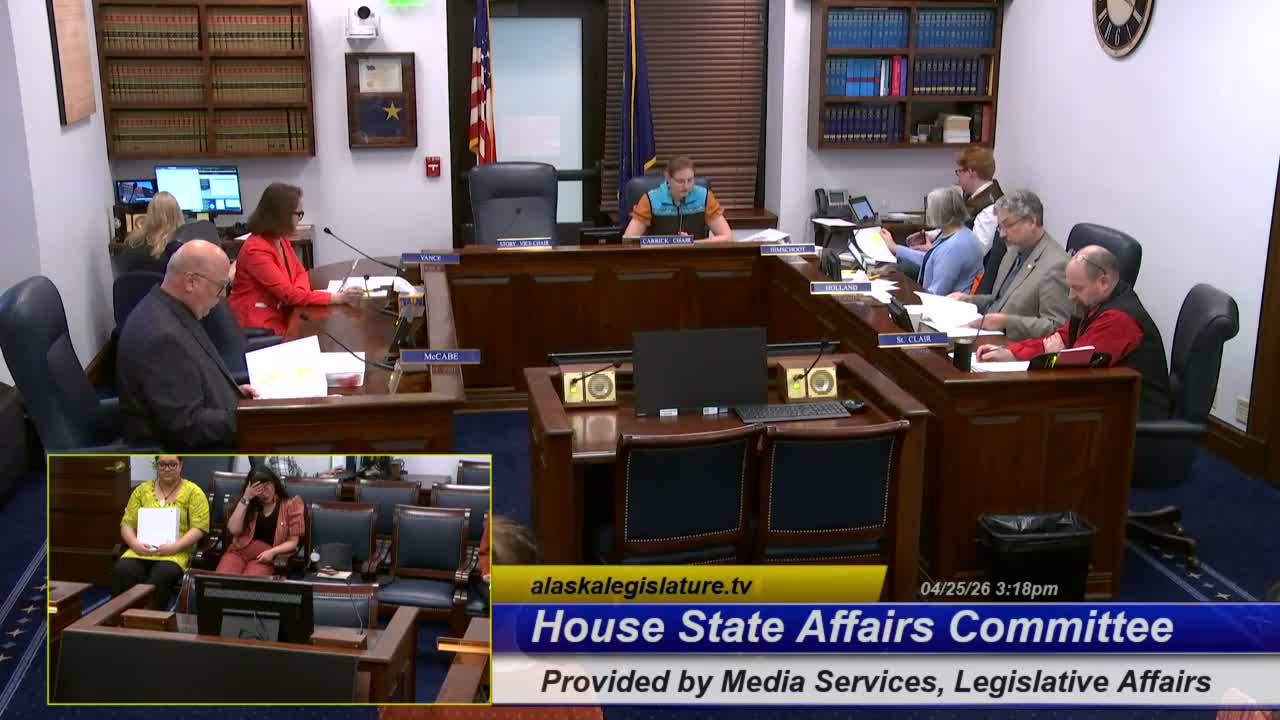
Representative Kevin McCabe told the House State Affairs Committee on April 25 that House Bill 371 aims to give Alaskans clearer information about who funds political messaging in the state, particularly when that money comes from outside Alaska.
"This is not about limiting speech. It's about ensuring transparency so Alaskans can make informed decisions with full knowledge of who is trying to influence our elections," McCabe said as he introduced the bill and turned the committee to a sectional analysis by his staff.
Staffer Elisheva Almeida summarized the bill's principal changes: expanded reporting for independent expenditures and their contributors; new disclosure of bundled contributions; a requirement that entities maintain a physical Alaska address or appoint a registered agent; shorter reporting timelines for certain late contributions; limits on some groups' annual contributions; and an immediate effective date.
Committee members focused on how the bill would define and detect "bundled contributions," and whether dollar thresholds apply to individual donors within a bundle or to aggregated contributions. Chair Kerrick asked McCabe to clarify how APOC (the Alaska Public Offices Commission) currently treats bundling and whether the agency has a term for the practice. McCabe described bundling as routing many small donations through an intermediary so individuals’ names do not appear on APOC filings.
Several legislators raised the practical and legal questions that the committee will need to resolve. Representative Holland asked whether the bill's $10,000 threshold applies to each individual in a bundle or to the total the aggregator delivers; McCabe said the provision targets large, outside donors and acknowledged the language may require amendment. Multiple members urged switching reporting rules from calendar years to election cycles to prevent end‑of‑year “gaming.”
Members also questioned whether APOC has the staffing and technical capacity to implement and enforce faster or more detailed reporting requirements. "They are not doing that," McCabe said, describing how the agency tends to act on complaints rather than proactively examining every filing, which can leave candidates facing delayed penalties years after filings were submitted.
The committee discussed constitutional limits—including Citizens United case law—and the need to tailor disclosure to avoid likely court challenges. McCabe said he consulted legislative legal counsel while drafting the bill and expects further amendments.
Chair Kerrick said the committee would continue work on HB 371 when time allows; no final action was taken on the bill at this hearing.
The committee left the record open for further technical suggestions and indicated it will revisit the measure later in the session.