Get Full Government Meeting Transcripts, Videos, & Alerts Forever!
Get email alerts on the Native Languages topic
No spam. Unsubscribe anytime.
Bill would create Alaska Native Languages task force to shore up research, teacher pipelines, witnesses say
Summary
House Bill 387 would establish a bicameral task force to review Alaska’s academic infrastructure supporting Alaska Native languages; witnesses from the Alaska Native Language Center told the committee decades of research and staffing have been eroded and urged stable funding and a coordinated strategy.
Rep. Andy Story introduced House Bill 387 on April 27 as a bicameral Alaska Native Languages academic task force charged with reviewing the state’s research, teacher‑training and archival capacity to preserve and revitalize Alaska Native languages.
"Decades of research, documentation, and teacher training... are at risk due to staffing shortages, unstable funding, and declining institutional capacity," Story said, noting the Alaska Native Language Center (ANLC) was established by the legislature in 1972.
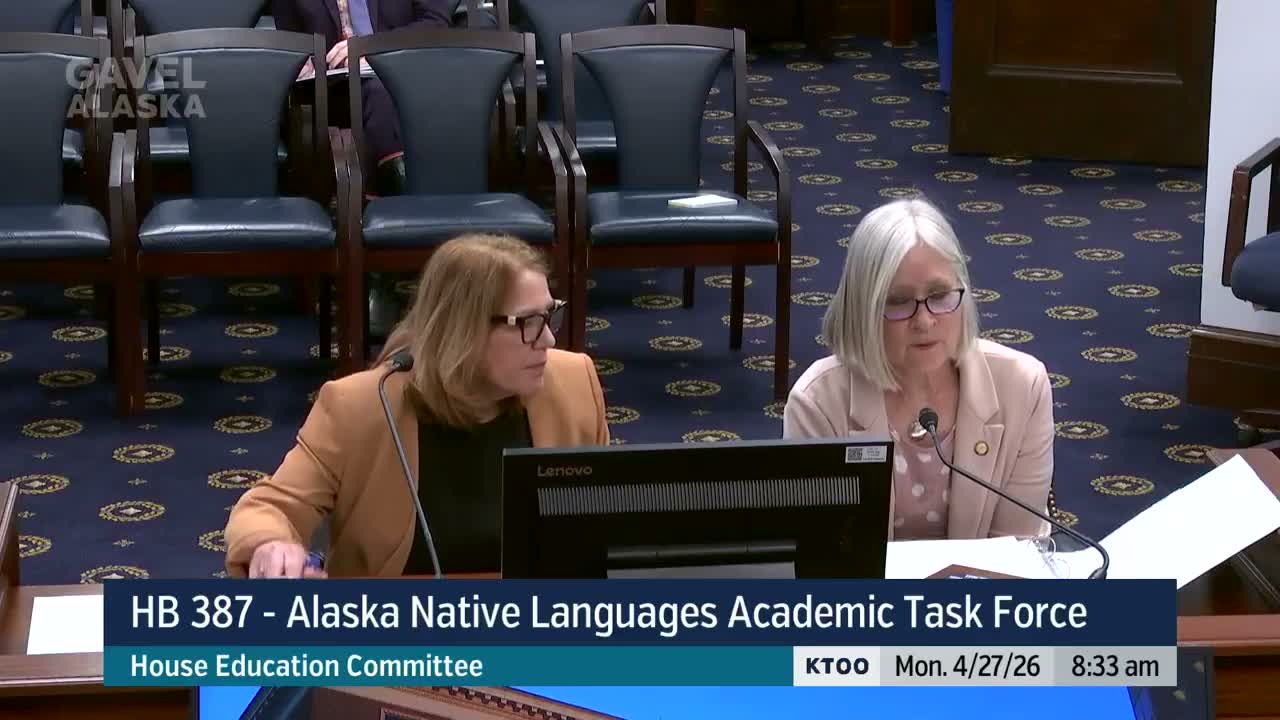
Sam Alexander, department chair at the ANLC (University of Alaska Fairbanks), testified in strong support. He told the committee staff losses and funding gaps are shrinking the center’s ability to produce grammars, dictionaries and teacher materials that communities need. "We're losing a lot of the remaining fluent speakers, and that's gonna occur within this next decade," Alexander said. "There is no second chance once they're gone."
Anna Bergey, director of the Alaska Native Language Archive, said the center has lost permanent research expertise and shifted toward short‑term, temporary contracts that undermine cumulative expertise. "In the past 15 years, ANLC has lost about 95% of its expertise," Bergey said, and she urged the committee to consider stable, sustained funding rather than short‑term or 'soft' money.
Witnesses told members that Alaska has 23 officially recognized indigenous languages that the task force should study at a high level (they recommended focusing on language‑level needs first, with dialects examined in community contexts). The proposed task force would engage communities, review institutional responsibilities within the University of Alaska system and recommend statutory and funding changes to grow teacher pipelines and research capacity.
Committee members asked about the scope (languages versus dialects), whether low morale was documented by survey (Alexander said it was observed through departures and retirements rather than a formal survey), and staffing counts (Alexander described a very small on‑site staff, including a single part‑time assistant and limited research faculty). The sponsor and staff said the committee will return with a more detailed sectional analysis, fiscal note and public testimony at a later hearing and suggested inviting university representatives back for further questions.
No vote was taken; the committee will schedule additional hearings to review the bill’s sectional analysis, fiscal implications and public comment.