Get AI Briefings, Transcripts & Alerts on Local & National Government Meetings — Forever.
Galena credits grant-funded early‑childhood programs for improved early-grade outcomes, warns of sustainability risk
Summary
Galena City School District told the Alaska House Education Committee its grant-funded early-childhood center, preschool and extended-day interventions are raising early-grade literacy and math scores, but leaders said those gains rely heavily on time-limited grants and tribal subawards.
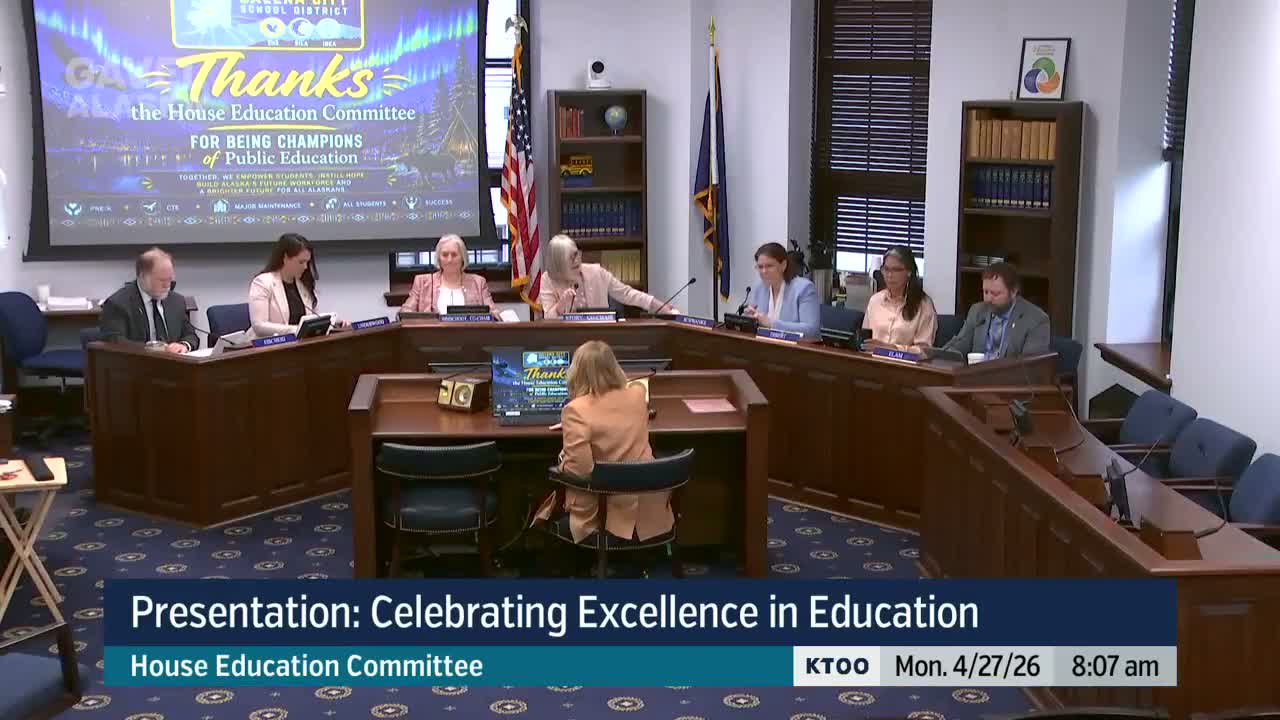
Lisa Shelby, assistant superintendent of the Galena City School District, told the House Education Committee on April 27 that a state‑licensed childcare center housed inside Sidney Huntington School and aligned preschool programs are producing measurable gains in early reading and math.
"We use the same curriculum with our 8‑month to 3‑year olds in our licensed daycare center as we do in our other preschool programs," Shelby said, describing a program sequence intended to prepare children for the Alaska Reads Act expectations by third grade. She said the district follows explicit science‑of‑reading instruction and uses data‑driven interventions to shrink the proportion of students scoring in the lowest bands.
Shelby described a package of supports: a licensed daycare for infants and toddlers, a three‑year‑old preschool, a combined 3–4 program, after‑school and summer programs, and two daily intervention blocks (about 35 minutes each). To create time for interventions, Galena extended the school day by about 45 minutes ‘‘without extending our teacher contract,’’ she said, adding the schedule change was negotiated and relied on shifting pre/post‑school time.
Committee members focused questions on scale and sustainability. Shelby said Galena’s on‑the‑ground enrollment is a little over 300 students across two schools — Sidney Huntington School (preK–12) and Delina Interior Learning Academy (a residential boarding school) — and that many programs are funded by a patchwork of tribal subawards and state and federal grants. "Our grant writer wears many hats," she said, explaining the district shares grant and federal‑programs staff across the district to secure and administer awards.
Shelby and multiple legislators emphasized that while the early interventions appear effective, they are largely not permanently funded. "Many of these successes are dependent on grants and are not sustainable long term," she told the committee, adding the district would welcome more stable state support for early‑childhood programs.
Committee members thanked Shelby for the district’s work and said they plan further hearings and follow‑up questions about equity, subgroup results (free and reduced lunch, English‑learner status) and how the district engages homeschool families in early learning.