Get Full Government Meeting Transcripts, Videos, & Alerts Forever!
Get email alerts on the Trust Law topic
No spam. Unsubscribe anytime.
Sen. Matt Klayman's bill to modernize Alaska trust law presented to Senate committee
Summary
Senate Bill 234 would replace Alaska's current fiduciary income law with an updated Alaska Fiduciary Income and Principal Act (AS 13.39), expand judicial discretion, modernize unit-trust treatment, and apply to existing trusts; Peak Trust Company and trust-law professionals backed the change.
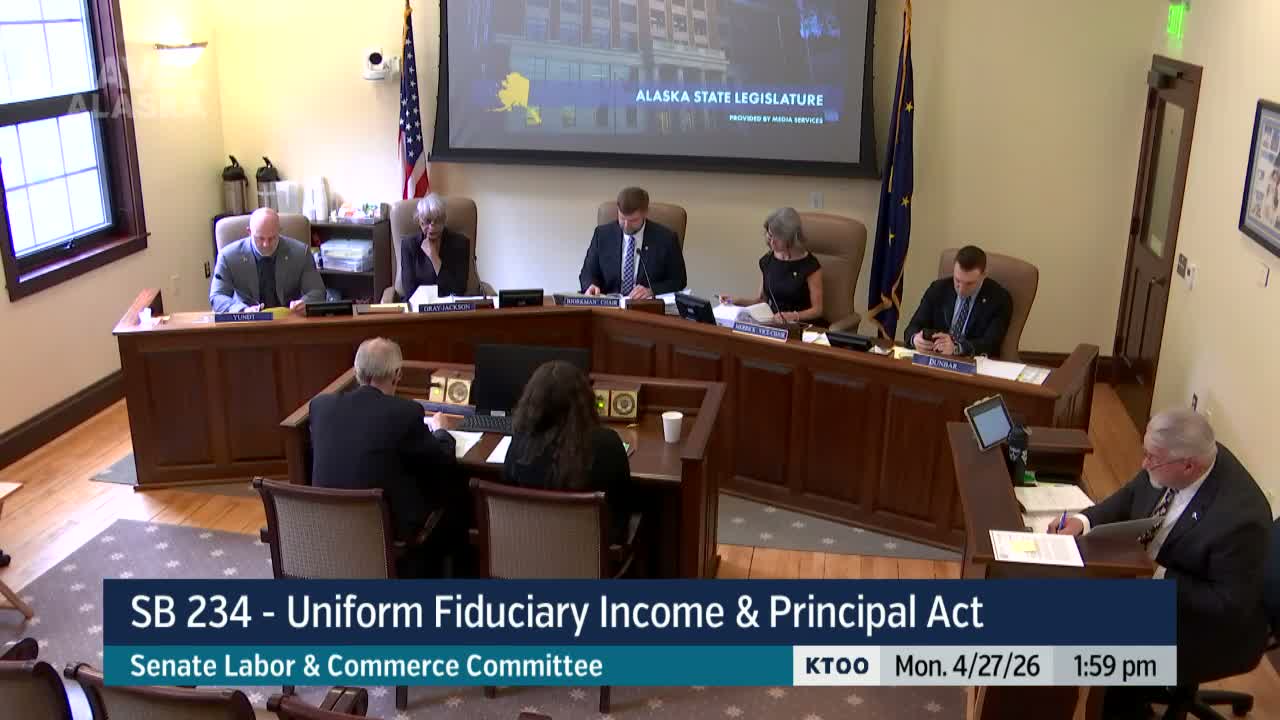
Senator Matt Klayman presented Senate Bill 234 to the Senate Labor and Commerce Committee on April 27, describing it as a comprehensive update to Alaska's fiduciary income and principal law intended to modernize trust administration and keep Alaska competitive as a trust jurisdiction.
Klayman said the bill would replace the existing Alaska Fiduciary and Income Act with the Alaska Fiduciary Income and Principal Act to allow fiduciaries to employ modern portfolio theory and to update statutory definitions. Serena Hackenmiller, staff to Senator Klayman, gave a sectional analysis saying the 52-page bill has six sections, would repeal the current act (AS 13.38) and enact chapter 39 (AS 13.39), enhance judicial discretion with a good-faith standard, modernize unit trusts (including conversion without a court order), expand the act's scope to additional trust-like arrangements and add judicial oversight and safeguards. Section 6 would apply the act to existing trusts and add receipt conditions for fiduciaries handling certain natural-resource receipts.
Abigail O'Connor, chief legal officer at Peak Trust Company and a member of the Alaska Trust and Estates Professionals Group, testified in favor. She said trustees need updated rules for allocating receipts and disbursements between income and principal and described the practical benefit of unit trusts over income-only trusts: "A unit trust... allows for a more stable distribution standard and the beneficiary now knows how much he or she will receive throughout the year," she explained. During questioning, O'Connor clarified that an income-only trust pays income but not principal and that unit trusts distribute a percentage of the trust value to beneficiaries, which can aid budgeting.
The committee set SB 234 aside for future consideration. No vote was taken on the substantive provisions during this hearing; staff and trust-industry representatives remained available for follow-up questions.