Get Full Government Meeting Transcripts, Videos, & Alerts Forever!
Get email alerts on the State Budget topic
No spam. Unsubscribe anytime.
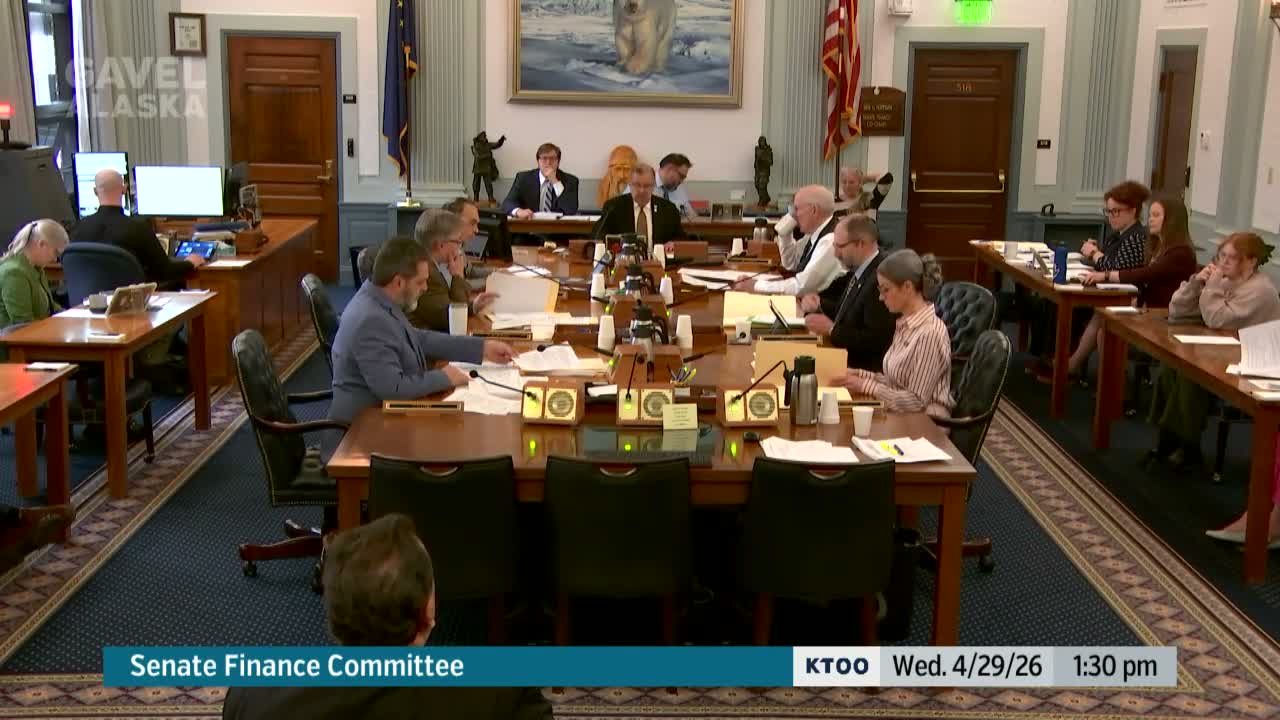
Senate finance panel rejects narrow POMV cut and three spending amendments to operating budget
Summary
The Senate Finance Committee considered CS2 of HB 263 and debated multiple member amendments — a 0.1 percentage-point cut to the POMV draw and three funding/reform proposals — but the committee defeated each amendment and set the bill aside for further consideration.
Senator Hoffman, chair of the Senate Finance Committee, led consideration of the Senate committee substitute (version e) of HB 263, the operating-budget bill, after staff summarized fund-source and line-item changes.
Pete Eklund, staff to the committee, outlined roughly $13.8 million in new unrestricted general funds in the CS2 package and described department-level changes including added UGF for Mount Edgecumbe utilities, tribal TANF maintenance-of-effort increases in public assistance, DPS dispatch and rural trooper housing shifts, PSEA salary adjustments of about $5.6 million, and supplemental election-fund capitalization tied to the Help America Vote Act.
Senator Kaufman proposed a series of amendments focused on restraint and oversight. Amendment 1 sought to reduce the Permanent Fund's percent-of-market-value (POMV) draw from 5.0% to 4.9% so the state would retain more of the current windfall. Kaufman argued the modest change would signal restraint and preserve funds ‘‘in reserve,’’ while Senator Stedman and the chair noted the committee has discussed a phased reduction to 4.5% over five years and flagged assumptions such as a $73-per-barrel oil price for planning. The roll call on Amendment 1 recorded three yeas and four nays; the motion failed.
Amendment 2 would have added $1.5 million for the administration to hire a performance‑management contractor to identify inefficiencies and redundancies. Kaufman said the contractor, aided by AI tools, could produce recoveries that exceed the investment. The chair objected, citing prior eliminations and competing priorities. The amendment failed on a 2–5 roll call.
Amendment 3 aimed to tighten waterfall and reserve accounting language so revenue would be clearly identified by fiscal year rather than commingled. Proponents framed it as a transparency measure; opponents warned it could delay emergency energy‑relief distributions by months. That amendment also failed 2–5.
Senator Cronk offered Amendment 4 to provide $1 million for a long‑overdue geographic pay‑differential study required under statute (cited in the hearing as AS 39.27.030), saying the last comprehensive study was in 2008 and that rural pay disparities impede recruitment. The committee debated priorities and funding constraints; the motion failed 2–5.
After the amendment votes, the chair set HB 263 aside for further consideration the next day without adopting the revised CS as the final committee action.
What happens next: HB 263 will return to the Senate Finance Committee for additional deliberations and possible amendment or adoption at a future meeting.