Get Full Government Meeting Transcripts, Videos, & Alerts Forever!
Get email alerts on the Municipal Finance topic
No spam. Unsubscribe anytime.
Dalton council approves $130 million utilities revenue bond to fund local power project
Summary
The Dalton City Council approved Ordinance 26‑05 authorizing a $130,000,000 combined utilities revenue bond to finance a power‑supply project Dalton Utilities says will reduce wholesale purchases; counsel noted two minor ordinance edits and the bond will be validated in Whitfield County Superior Court.
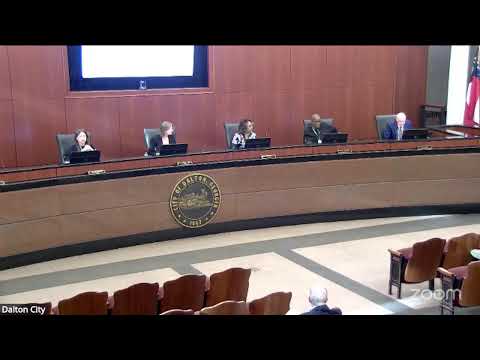
The Dalton City Council on March 30 approved Ordinance 26‑05, authorizing a combined utilities revenue bond in the principal amount of $130,000,000 to fund a local power‑supply project, the mayor said.
John, a representative of Dalton Utilities, told the council the project is needed “regardless of any data center activity in the community.” He said the utility expects about $1,000,000 in annual cash‑flow savings during the first 10 years of the bond and estimated longer‑term savings that the utility presented as “close to $200,000,000” over the subsequent 20 years, figures John described as utility projections.
Ed Anthony, chair of the Water, Light and Sinking Fund Commission, said the commission had been briefed repeatedly and “voted unanimously in favor of this project” because it believes the project is financially appropriate for Dalton Utilities and local electric customers.
Bond counsel Jonathan, appearing by Zoom, told the council there were two slight edits since the ordinance was published: a clarification in Section 3(d) to make clear that interest accrued may be paid during a partial early redemption period, and the addition of an amortization schedule as an exhibit. Counsel also explained that, following council approval, the bond will be validated in Whitfield County Superior Court, advertised and then offered to the market subject to court approval.
Council members asked whether the project would create surplus power for sale; John replied it would not, saying the city still expects roughly 15–20% of its power to come from the wholesale market after the project is online.
A council member moved to approve the ordinance; after a second and routine procedure checks the council approved by voice vote with no recorded opposition. The ordinance will proceed to the court validation step described by counsel.