Get Full Government Meeting Transcripts, Videos, & Alerts Forever!
Get email alerts on the Agriculture And Environment topic
No spam. Unsubscribe anytime.
Sen. Jason Bean’s bill would exempt older farm vehicles from emissions checks and ease cotton‑gin permitting; industry groups back the package
Summary
Senator Jason Bean presented Senate Substitute for SB 1033 to exempt certain farm vehicles (older than 10 years used within 50 miles) from emissions inspections and to remove DNR air dispersion modeling requirements for cotton‑gin permits; agriculture and industry groups testified in support and Missouri DNR said the air program will be insolvent by fiscal year 2028.
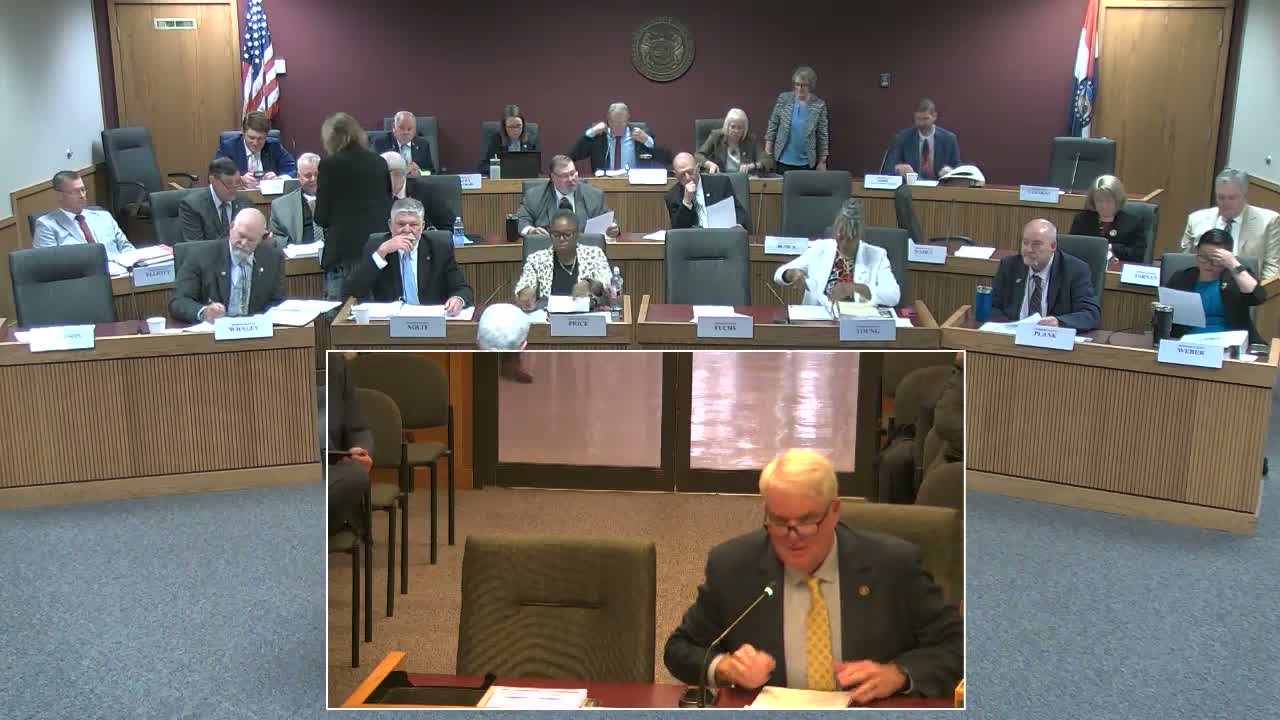
Senator Jason Bean (25th District) opened the committee hearing on Senate Substitute for Senate Bill 1033, saying the bill would exempt certain farm vehicles from emissions inspection requirements and would modify permitting requirements for cotton gins.
"This legislation would exempt certain farm vehicles from emission inspection requirements," Bean said, adding that the exempted vehicles would have to be "older than 10 years old and used just for local farming operations federally defined as covered farm vehicles" that "operate solely within 50 miles of the farm or just transport products to and from the owner's branch or farm." He also said the bill includes language that would remove a requirement for cotton gins to submit air dispersion modeling to the Department of Natural Resources (DNR) to obtain a construction permit, a change he said would "level the competitive playing field with Arkansas."
Industry and agricultural representatives spoke uniformly in favor of the bill. Brad Thielmeier, registered lobbyist for the Cotton Producers of Missouri, said Missouri has lost ginning capacity as neighboring states with more workable air permits have built or expanded gins, and urged the committee to support language making in‑state ginning more competitive. Mark Figenbaum of the Missouri Farm Bureau said retrofitting farm vehicles can be "extremely costly" and that exempting certain farm vehicles would reduce regulatory burdens on farmers and gin operators.
Other witnesses — including Dan Kleinsergy, executive director of INFA (quarries and sand operations); Randy Scherer for the Missouri Concrete and Mining associations; Mark Rhodes with the American Council of Engineering Companies; Shannon Cooper representing Missouri Forest Products and the Missouri Cattlemen's Association; Scott Swain of the Missouri Soybean Association; and Elena Fork with the Missouri Corn Grower Association — all went on record in support of parts of the bill, with several witnesses tying the permitting change to maintaining in‑state processing capacity.
On funding, Matthew Smith of Associated Industries of Missouri described language, related to a separate air‑pollution funding bill Senator Bean referenced, that would establish an alternative funding stream for the air pollution control program. Smith said "the fiscal note on our bill specifically states that it would generate more or less than $3,000,000 in fiscal year 2028" and described the proposal as a way to stop fund sweeps to general revenue so money would remain dedicated to the program.
Ally Gatwood, legislative liaison for the Missouri Department of Natural Resources, appeared for informational purposes and said the air pollution control program "will be insolvent in fiscal year 28" and offered to follow up on questions about program functions such as the Gateway Vehicle Inspection Program (GVIP).
Committee members asked clarifying questions about how many cotton farmers could be affected; witnesses and Senator Bean referenced a rough estimate in the range of about 150–200 farmers. Several lawmakers asked technical or procedural questions about fees and whether certain services constitute paid services; the chair directed some of those policy or voter‑policy questions to be taken offline.
The committee concluded the hearing on SB 1033 and adjourned after testimony.