Get Full Government Meeting Transcripts, Videos, & Alerts Forever!
Get email alerts on the Professional Licensure topic
No spam. Unsubscribe anytime.
Senator outlines broad licensure changes; committee gives SB1083 a 21-1 do-pass
Summary
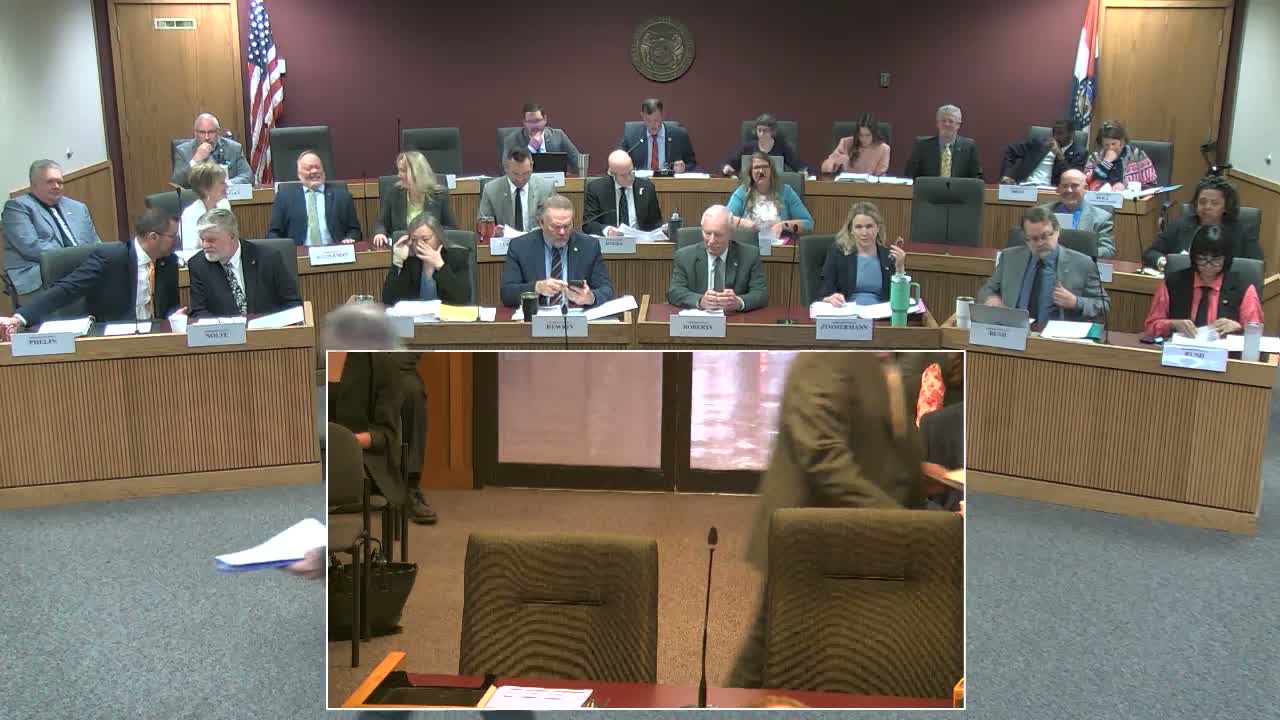
The House Committee on Professional Registration and Licensing advanced the House committee substitute for Senate Substitute for Senate Bill 1083 by a 21-1 vote after adopting a chair amendment. The bill would tighten respiratory-therapy credential requirements, ease supervision timelines for social workers, expand interior-designer practice scope, and fix SLP fellowship supervision rules.
A senator presented the House committee substitute for Senate Substitute for Senate Bill 1083 to the House Committee on Professional Registration and Licensing and defended changes that would require registered respiratory therapists (RRTs) to hold an active RRT credential to practice in Missouri and add a random-audit check at license renewal.
The bill’s sponsor said the RRT requirement addresses a testing gap that currently allows some practitioners to qualify as certified respiratory therapists (CRTs) after a lower cut score on a written exam without passing a simulation-based clinical exam. “As a profession, respiratory therapists want to hold themselves to the highest standard of care by requiring the RRT,” the sponsor said, and that the measure includes “a robust grandfather clause” to let current CRTs continue practicing under their existing credentials.
Why it matters: Committee members and several professional associations told the committee the credential and the renewal-audit language are intended to protect patients and ensure providers maintain active credentials. Brandon Burke, government affairs chair for the Missouri Society for Respiratory Care, testified the group supports the language and emphasized its patient-safety rationale: “We feel it’s very important to advance our profession. It’s mostly important to our patients to ensure they’re getting the highest quality of respiratory care in the state.”
The substitute also incorporates several Senate amendments affecting other licensed professions. Sponsor remarks and witnesses outlined the key additions:
• Interior designers: The substitute would dissolve or move the current interior-design council into a broader board for design professionals and allow licensed interior designers to practice to the full extent of their training and to stamp technical submissions, a change the sponsor said would lower construction costs and help small, often women-owned businesses. Kaina Eiman, representing the Interior Designers Association, said the association supports the legislation and had made additional changes requested by the board.
• Physicians: The substitute adds requirements that physician-licensure applicants submit to criminal background checks, list prior licenses from other jurisdictions, and disclose past or pending investigations or disciplinary actions.
• Social workers: The bill reduces the required supervisory experience for a licensed social worker serving as a supervisor from five years to three years, a change the sponsor described as important in rural areas where finding supervisors has been difficult.
• Speech-language pathologists (SLPs): A technical fix would allow clinical fellowships completed under the supervision of a licensed SLP in good standing from any state, removing a barrier for practitioners who received supervision outside Missouri and facilitating participation in the SLP compact.
During questioning Representative Nolte challenged the sponsor’s assertion that the interior-design registration board was “in full agreement” with the changes, saying the board had not formally agreed and that prior communications had been routed through the director rather than board members. The sponsor and testimony from Kaina Eiman offered differing accounts of whom they had consulted, with the sponsor saying the professions had reached a place of agreement and Nolte disputing that assertion.
Other witnesses who spoke in favor included Megan Howerton of the Missouri Speech-Language and Hearing Association (supporting the SLP provision), Jessica Petrie Telemaque of the National Association of Social Workers–Missouri chapter (supporting the social-work supervision change), and James Harris of FGA Action, who suggested folding additional companion bills into the committee substitute.
In executive session the chair distributed and moved adoption of a committee amendment (identified in the record with an ending of ".07h") that clarified temporary credential language for residential care and assisted-living facilities and expanded the SLP supervision language to apply across states. The committee adopted that amendment and then voted to roll it into the committee substitute.
The committee then voted to give the House committee substitute for Senate Substitute for Senate Bill 1083 a do-pass recommendation. The roll call produced a 21-1 tally; Representative Nolte cast the lone no vote. The chair announced the committee’s do-pass recommendation and adjourned.
The committee’s action sends the committee substitute forward with a do-pass recommendation; the transcript does not record the next formal chamber step or any floor action date.