Get AI Briefings, Transcripts & Alerts on Local & National Government Meetings — Forever.
Sen. Sanders panelizes experts who say runaway AI could threaten humanity and urge global cooperation
Loading...
Summary
Sen. Bernie Sanders convened AI researchers who warned advanced AI could pose catastrophic risks, cited expert estimates for nontrivial extinction risk, and urged international cooperation and faster regulation to avert scenarios they described as an existential threat.
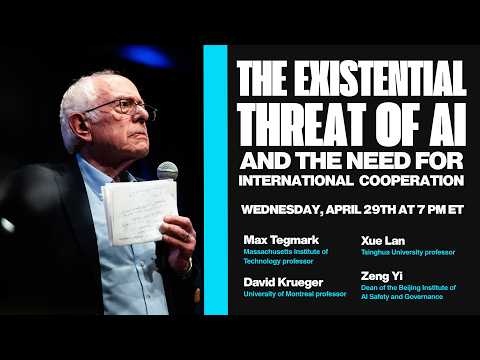
Sen. Bernie Sanders convened a panel of AI researchers and scientists who warned that rapidly advancing artificial intelligence could pose catastrophic risks to humanity and urged countries to cooperate to prevent a global crisis.
The senator opened the session by framing AI as "the most profound technological revolution in world history," citing large corporate investments and expert warnings that advanced AI could have far-reaching consequences for jobs, privacy, elections and public health. He quoted recent expert statements urging a pause in advanced-model development and asked panelists whether predictions that AI might pose an existential risk were exaggerated.
Panelists from the United States and China said the risk is real. Dr. Max Tegmark (professor at MIT) said the chance of a civilization-ending outcome may be higher than commonly cited figures if development continues without effective controls. Dr. David Krueger (assistant professor, University of Montreal) described the situation as an "acute crisis," noting that researchers lack reliable methods to align autonomous AI agents with human goals. Dr. Zhang Yi (dean, Beijing Institute of AI Safety and Governance) emphasized a mismatch between public perception and technological reality and cautioned that current systems process information without human-like understanding.
All speakers said mitigation requires action at the national and international level. They cited the 2023 letter signed by over 1,000 AI experts that called for a temporary pause on certain advanced-model development and urged governments to be prepared to intervene if industry safeguards are inadequate. Panelists said multinational mechanisms exist—AI summits and UN dialogues among them—but described them as fragmented and behind the pace of technological change.
The panelists repeatedly compared the diplomatic challenge to Cold War–era arms-control efforts, saying shared existential stakes could create incentives for cooperation even among geopolitical rivals. They urged concrete, implementable steps rather than only consensus statements.
The panel ended with Sanders thanking the guests and urging that the issue be elevated internationally and pursued through sustained diplomatic and regulatory effort.