Get AI Briefings, Transcripts & Alerts on Local & National Government Meetings — Forever.
Council committee debates shelter‑capacity bill and multiple operational amendments
Loading...
Summary
Committee members and staff debated Council Bill 121195, which would raise capacity limits for certain transitional encampments, and considered amendments on public safety plans, good neighbor agreements, staffing ratios, security and separation distances from schools and large parks; no final committee vote was recorded.
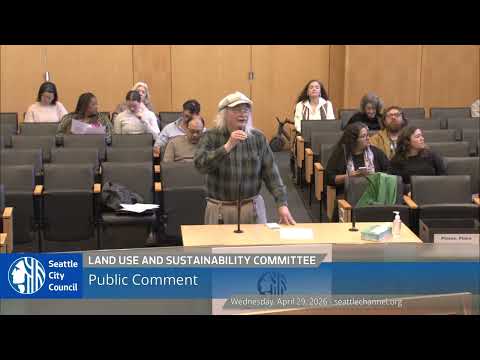
The Land Use and Sustainability Committee on April 29 held an extended discussion of Council Bill 121195, the land‑use measure to expand capacity for certain transitional encampments (micro‑modular/tiny‑home villages and RV sites). Committee members, central staff and community witnesses debated multiple operational amendments covering public‑safety planning, good‑neighbor agreements, staffing, neighborhood partitioning and proximity to schools and parks.
Keto Freeman and Jennifer Lebrecht of council central staff reviewed a packet of proposed amendments and explained how some operational requirements mirror language the council adopted in the recent budget. Council member Foster described one amendment to require monthly public safety reporting that would pull from incident reports, neighbor agreements and 911 calls so council members have up‑to‑date information on newly authorized sites.
Other amendments discussed included a sponsor proposal to require a Good Neighbor agreement with a posted point of contact and response timelines (sponsored by Council president Hollingsworth), an operability requirement for at least two staff on site 24/7 (sponsored by Council member Rink), a non‑binding goal to staff case management for high‑acuity residents at roughly a 1:15 ratio, neighborhood partitioning into 50‑person subunits to preserve privacy and quicker staff response (sponsored by Council member Strauss), and proposals to require 24‑hour security or identifiable security personnel at sites (sponsored by Council member Rivera/others).
Council members pressed staff and sponsors on operational practicality and cost. Central staff noted the emergency interim zoning in the bill is framed prospectively and that most operational amendments as drafted would apply to new or expanded sites authorized after the bill’s effective date (not retroactive to existing encampments). Staff also said some budgeting assumptions had included two staff present 24/7 but did not assume private, contracted security in every case.
A particularly contested proposal would require new or expanded sites to be located at least 750 feet from primary/secondary schools, childcare centers and playgrounds, and 500 feet from parks larger than two acres, with carve‑outs for family‑only or sober facilities. Sponsors framed the buffer as a reasonable safety measure for children and neighborhoods; other members warned the rule could unintentionally restrict suitable locations and said language might need refinement.
No final vote on CB121195 or its amendments was recorded before the committee adjourned. Committee members and sponsors said they would continue work to refine language, reconcile operational responsibilities between providers and the executive, and resolve funding questions before returning the bill to committee.
What’s next: Sponsors and central staff indicated continued drafting and follow‑up with the executive to align operational expectations and to surface cost estimates; the bill remains under committee consideration.