Get AI Briefings, Transcripts & Alerts on Local & National Government Meetings — Forever.
Gates County commissioners press school board for itemized budget savings and staffing details on $3.2M planning ask
Loading...
Summary
At a joint April 29 meeting, county commissioners pressed the Gates County School Board for written analyses and line‑by‑line justifications for a roughly $3.16–$3.20 million local planning budget ask and for the projected savings and one‑time costs tied to closing Buckland Elementary.
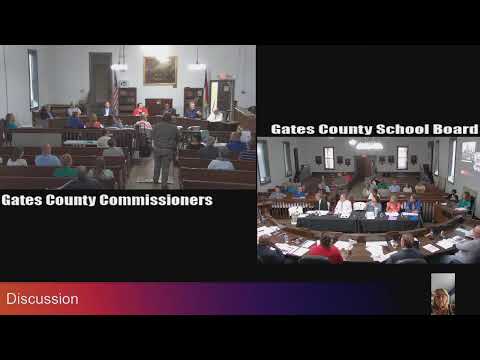
A Gates County joint special meeting on April 29 turned into a detailed run‑through of the Gates County Schools planning budget and a pointed push by county commissioners for written backup on savings from a planned school consolidation. The Board of Education presented a planning resolution and a local funding request (figures discussed between $3,163,000 and $3,198,000) and described a capital appropriation breakdown; county commissioners repeatedly requested an itemized savings and staffing analysis before committing local appropriations.
The school presentation framed the document as a planning resolution (policy direction) distinct from the legally binding budget resolution the commissioners will later appropriate. Superintendent Dr. Williams said the total planning document shows local, state and federal funding, including a capital request of $561,695.47 (a school bus appropriation of $261,000 and a county appropriation of $300,000) and a grand total plan and budget figure of $21,853,742.07 as presented to the boards.
Why it matters: county commissioners determine the appropriation of local funds to schools. Commissioners said they need concrete, written evidence of projected personnel savings, utility and maintenance reductions and one‑time transition costs associated with the closure of Buckland Elementary before they can responsibly fund the school request.
During the meeting, commissioners asked for a statutorily required closure analysis showing the number of positions that would be affected, annual utility and maintenance savings, custodial changes and the one‑time costs of consolidation. One commissioner said the requested summary "should have been generated already" and called the lack of a written, line‑by‑line report "ludicrous." The superintendent replied that some specifics on personnel‑related reductions are the subject of Board of Education deliberations and closed‑session personnel conversations and therefore could not be released as final figures yet; he said the school board has prepared options the board will vote on and that once the board provides criteria he can provide precise savings.
On compensation and recurring charges, the district staff explained that a $272,500 local line for staff supplements (county supplements) includes benefits and that roughly $233,000 of that allotment goes to teacher supplements. Officials clarified that stipends for extra duties are recorded separately from recurring supplements, and that FICA (7.65%) and retirement contributions (noted at roughly 24.67% in discussion) are added on top of supplements.
Special education and other program gaps were a recurring point. District staff said state EC (exceptional children) funding is a flat percentage of the budget (commonly about 13%), while the district currently has roughly 19% of students identified for EC services; the gap requires local supplementation. The district also asked for an additional $360,000 across three priorities — $150,000 for child nutrition, $80,000 for technology, and $130,000 for exceptional children services — and indicated those requests reflect rising costs and service needs.
Capital and maintenance needs also drew close attention. Facilities staff reported aging rooftop heat‑pump equipment (installed in 1998 on the sixth‑grade wing at Central Middle School) and identified repaving, HVAC replacement and a wastewater pump as significant near‑term needs. Commissioners asked the district to supply a prioritized capital list so the county can fund the highest‑risk projects first rather than funding the full wish list.
What happened procedurally: the Board of Education moved and approved the amended planning budget resolution as presented that day; the county board amended its own agenda to add public comment at the start of the meeting and adjourned after the budget discussion. Commissioners requested the detailed breakdowns in writing "as soon as possible" and indicated they expected further joint sessions before the county adopts its budget.
What’s next: Commissioners asked the school board to provide the requested written analyses — the closure savings report, itemized supplement vs. stipend listings, prioritized capital outlay, and recurring technology costs — ahead of the county appropriation decision. The boards discussed follow‑up work sessions and a target timeline that referenced May meetings and a desire to finalize the county budget in May if possible.
Speakers quoted in this article are drawn from meeting remarks and include the superintendent and multiple county commissioners and school financial staff. Direct quotations and statistical figures are taken verbatim from the publicly read presentation and spoken exchanges at the April 29 joint meeting.