Get AI Briefings, Transcripts & Alerts on Local & National Government Meetings — Forever.
Sumner hears multi‑agency briefing on battery energy storage, safety and state permitting for proposed Greenwater BESS
Loading...
Summary
City staff, Puget Sound Energy, East Pierce Fire & Rescue and the state Energy Facility Siting & Evaluation Council briefed Sumner council on battery energy storage systems, a proposed 200 MW/800 MWh Greenwater BESS near the White River substation, public‑safety planning and the option for developers to use the state FSEC siting process.
Sumner planning staff, Puget Sound Energy (PSE), East Pierce Fire & Rescue and the Energy Facility Siting & Evaluation Council (FSEC) briefed council at a study session on April 27 about battery energy storage systems (BESS), the city’s adopted large‑scale BESS code, and a proposed utility‑scale project sited near the White River substation.
Krishanda Walker, associate planner, said the city began receiving inquiries after PSE posted a regional RFP in 2021 and that the Bright Knight team (transcript records also show the name spelled "Bridal Knight" in places) submitted a pre‑application in August 2022. The project proponents filed SEPA and a conditional‑use permit in February 2024, triggering a public engagement process that included community open houses and hearings. Walker described the selected site as approximately eight acres in an M‑1 light industrial zone near East Valley Highway, and staff said the proposal is a 200 MW / 800 MWh utility‑scale system with a transmission connection to the White River substation.
PSE representatives framed BESS as a tool to meet state clean‑energy mandates (CETA) and to integrate renewables; Christine Nahn said PSE has become coal‑free and is targeting capacity additions, while Anne Marshall described two deployment pathways — front‑of‑meter RFPs and a residential flex‑battery program. PSE said the Greenwater resource will provide capacity support to the grid and be connected to regional transmission.
East Pierce Fire & Rescue described its review role and operational planning. Deputy Chief Kevin Stenfeld said the vendor provided an incident response plan that the department reviewed, the vendor incorporated fire‑district feedback and the department will run site‑specific training. On firefighting tactics, Stenfeld said the industry’s approach to these incidents often focuses on protecting exposures and evacuations rather than extinguishing battery racks: “We will not put these fires out. They will burn until they self extinguish,” he said, noting that on‑site monitoring (a weather station) and hydrant placement were among recommended mitigations needed to manage plume, dispersion and evacuation decisions.
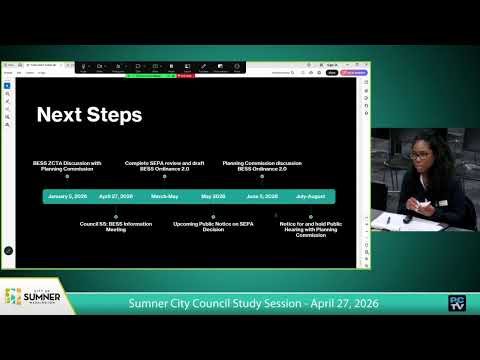
Staff outlined code changes already adopted in BES Ordinance 2899 (which establishes large‑scale utility definitions, performance standards including decommissioning bonds and emergency‑management plans, and a 1,000‑foot residential setback) and proposed BES Ordinance 2, which would divide BESS into four tiers so the city can regulate mid‑scale and smaller installations differently from large utility projects. Walker said staff intends to bring the Ordinance 2 draft to the planning commission later this year for public hearing and recommendation.
FSEC staff described the state siting option: large energy facilities can elect FSEC’s consolidated review instead of local permitting; FSEC performs SEPA, permit identification, adjudication where needed and recommends to the governor, who has final approval authority. FSEC emphasized that projects approved through the state process remain subject to conditions for construction, operation and decommissioning and that interagency coordination and reimbursement are available to support local review.
Council members asked about plume modeling and the health implications of emissions from a battery fire; staff said early research did not find local plume modeling in the city’s materials and that staff would consult federal labs such as the Pacific Northwest National Laboratory for science on combustion byproducts. Council also asked about who pays for additional hydrants and site improvements (staff said costs would be borne by the applicant and would be enforced through permit conditions and bonding) and whether local denial would be preempted by a state FSEC application (FSEC said applicants retain the option to file with FSEC).