Get Full Government Meeting Transcripts, Videos, & Alerts Forever!
Get email alerts on the Historic Preservation topic
No spam. Unsubscribe anytime.
Harlingen preservation council hears urgent repairs and funding shortfall for Carlogine Hospital, a Texas historic landmark
Summary
Museum manager Angie Anderson told the Harlingen Historic Preservation Council the Carlogine Hospital faces significant structural deterioration; estimated repairs top $100,000, the Rio Grande Valley Museum Association has $20,000 earmarked, and the council discussed applying for state preservation grants and seeking THC guidance.
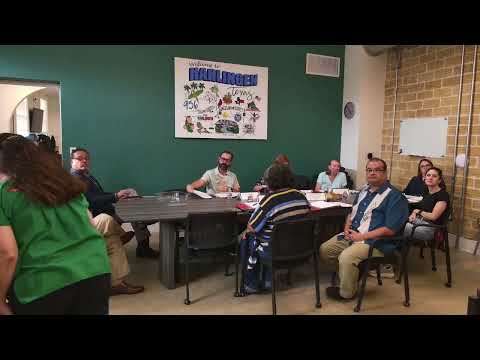
At the Historic Preservation Council’s inaugural meeting on April 23, museum manager Angie Anderson urged the council to act quickly to stabilize and rehabilitate the Carlogine Hospital, a building recorded as a Texas historic landmark.
Anderson said the structure dates to 1916 and later housed one of the city's earliest hospitals; it was recorded as a Texas landmark in 1980 and was moved to the Arlington Arts and Heritage Museum in the early 1980s. She described extensive deterioration: large holes in the roof, leaning exterior sidewalls, wallboards shifting, and windows whose panes are held with clear tape.
Anderson said the Rio Grande Valley Museum Association has an estimated $20,000 earmarked toward initial repairs but that full rehabilitation will require specialized contractors and historic-preservation expertise. Council members and staff cited contractor estimates assembled by public works: roughly $67,000 for roof replacement, about $22,000 for exterior/porch repairs, and roughly $32,000 for interior work — a combined estimate exceeding $100,000.
Members discussed whether to prioritize wall stabilization (installation of structural brackets recommended by the Texas Historic Commission) or roof replacement first; Anderson reported contractors gave conflicting advice and said the Texas Historic Commission (THC) should be consulted for an authoritative recommendation. The council agreed that a current assessment and clear bid documents from a qualified historic architect would be necessary before launching a competitive procurement process.
Council members recommended pursuing available grants, noting that the existence of an official preservation board makes some grant applications easier. The council’s grant and city staff were asked to gather application requirements, contractor lists, and THC guidance and to report back at the next meeting. The council also discussed outreach steps including a logo unveiling and a press release planned for Historic Preservation Month in May.
No final funding decision was made at the meeting; council members emphasized next steps: secure a THC assessment or updated architectural evaluation, prepare clear bid specifications with a historic architect, and pursue grant opportunities such as the Texas Preservation Trust Fund.