Get AI Briefings, Transcripts & Alerts on Local & National Government Meetings — Forever.
House Ways and Means advances bill to create centralized inspector general office, delays OIG police powers until 2028
Loading...
Summary
The Minnesota House Ways and Means Committee voted to send Senate File 856, establishing a statewide inspector general for executive-branch programs, to the general register after adopting an A36 amendment that funds the office, adds technical changes and postpones any OIG law-enforcement authority until Jan. 1, 2028.
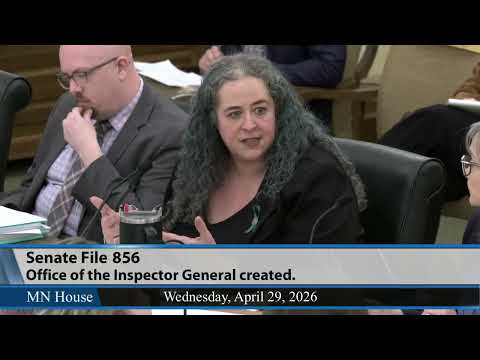
The Minnesota House Ways and Means Committee advanced Senate File 856 on a voice vote Thursday after adopting an amendment that funds the office and postpones any inspector-general law-enforcement authority until 2028.
Representative Nora Norris (coauthor of the bill) told the committee the A36 amendment reflects a bipartisan, bicameral agreement that resolves remaining sticking points and “includes the appropriation language for the bill” while retaining — but deferring — the OIG’s authority to create a law-enforcement unit. "The authority does not take effect until 01/01/2028," Norris said, and in the interim the new office may work with the Bureau of Criminal Apprehension under an interagency agreement.
The amendment also contains a funding package to stand up the statewide Office of Inspector General, miscellaneous technical cleanups and provisions intended to embed subject-matter staff in agencies where appropriate. Representative Anderson, a coauthor and former state auditor, described the measure as a compromise to preserve expertise: embedded staff would remain statewide OIG employees but focus on agency-specific programs such as education oversight.
Committee members pressed the authors and nonpartisan staff on several provisions. Representative Mueller asked whether the bill’s law-enforcement cooperation language would include federal authorities; nonpartisan counsel said the statute cited in committee (Minn. Stat. 626.84) defines law-enforcement agencies subject to POST-board oversight and that clearer cross-references could be added. The authors said they would confer with nonpartisan staff to tidy language.
Several members raised concerns about duplication of oversight. Representatives and staff discussed how the new executive-branch OIG would coordinate with the Office of Legislative Auditor (OLA) and existing agency inspectors general, and whether the centralized office would conflict with federal Medicaid rules that designate a single state agency as lead for Medicaid. Representative Noor pressed the authors on the bill’s reporting structure and potential overlaps; Representative Norris said the bill places primary responsibility for Medicaid investigations with the Department of Human Services while allowing the centralized IG concurrent authority and said the working group sought CMS approval where appropriate.
Members also debated funding and staffing. Representative Claiborne proposed earlier amendments to add one-time and recurring IT and law-enforcement staffing dollars — including a divided A14 proposal to add $15 million for IT modernization and a later proposal to add $12.5 million per year for a law-enforcement unit — but those divided amendments failed on 14–14 roll-call results. The authors said the fiscal note and prior state budgeting conversations informed the A36 package; the bill as amended carries appropriation language to fund the office and some related agency responsibilities.
Nonpartisan staff clarified drafting points raised during questioning. For example, a word in the draft (“abuse”) was corrected to the defined term “misuse” in the amendment; staff also pointed to criminal-code cross-references and sections that require certain reports to be sent to both the legislative auditor and the statewide inspector general.
Supporters argued the centralized OIG would increase capacity to prevent and investigate misuse of state funds and to act more directly than a legislative auditor can. Critics warned the office risks duplicating the OLA and the Bureau of Criminal Apprehension, could create jurisdictional confusion, and needs tighter language around law-enforcement powers, oversight and the timing of budget and staff transfers.
After final remarks from the bill’s authors and co-sponsors, co-chair Frasier urged the panel to move a bipartisan agreement forward. The committee seconded a motion to refer Senate File 856, second unofficial engrossment as amended (including A36), to the general register; the committee adopted the motion and the bill was passed out of committee.
What's next: with the committee’s referral, the bill heads to the House general register; members and authors said they expect additional technical clarifications with nonpartisan staff before floor consideration.