Get Full Government Meeting Transcripts, Videos, & Alerts Forever!
Get email alerts on the Utilities Sewer topic
No spam. Unsubscribe anytime.
Council approves first reading of sewer-rate changes that include higher permit fees
Summary
On first reading the White House Board approved Ordinance 25-04, a staff-led proposal combining a 3% sewer user-rate increase with fee-structure revisions that staff said would roughly double certain capacity and permit charges over a six-year capital plan to support wastewater capital projects.
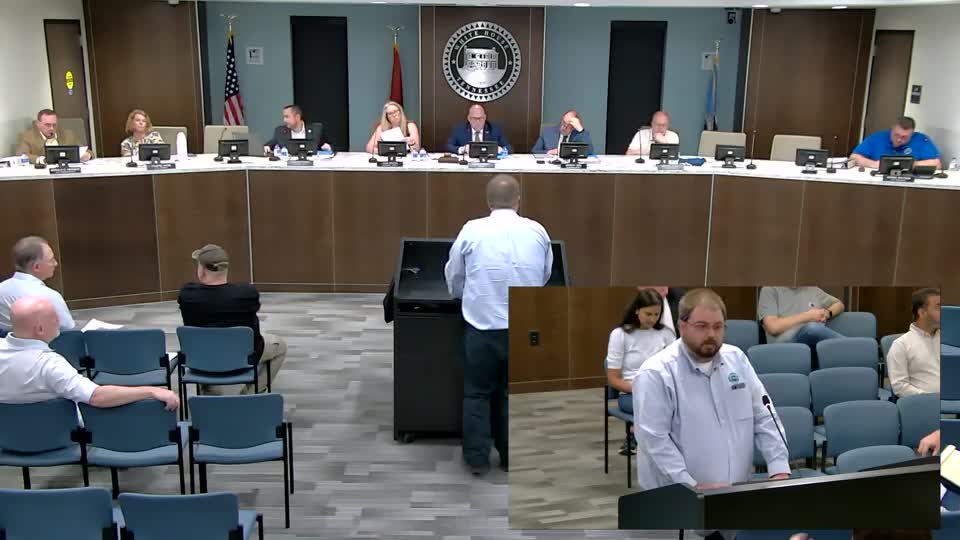
The White House Board of Mayor and Aldermen approved the first reading of Ordinance 25-04 on sewer rates and fees after a staff presentation explaining changes to sewer-user charges and permit fees.
City staff presented the proposal as a two-part approach: a 3% increase in annual sewer user fees and a restructuring of permit, capacity and application fees intended to align revenues with a six-year capital-improvement plan. "What we arrived at was roughly a doubling on these fees," the presenter said, adding the change was designed to cover projected capital expenses tied to growth and system needs.
The staff presentation included line-item detail: the current minimum charge for a new residential connection was described as $2,705 (comprising a $2,500 capacity fee, a $150 connection fee and a $55 application fee). Staff said the $55 application fee for new addresses would no longer apply to existing in-city moves, which would remain at a $30 rate. Other application and plan-review fees would be adjusted, and some items were increased to match department parity (for example, $500 fees adjusted to $600 to align with similar departmental practice).
Board members asked questions about the timing and fairness of increases and about comparisons to neighboring jurisdictions; staff said fee schedules vary widely and that the proposed structure seeks simplicity while meeting projected capital needs.
The ordinance passed its first reading by voice vote. As a first reading, the measure will return for final action at a subsequent meeting; staff indicated the changes are meant to support upcoming capital projects and the city's longer-term infrastructure obligations.