Get Full Government Meeting Transcripts, Videos, & Alerts Forever!
Get email alerts on the Parks Recreation topic
No spam. Unsubscribe anytime.
White House to remove partial rec center memberships, add general admission and update parks code
Summary
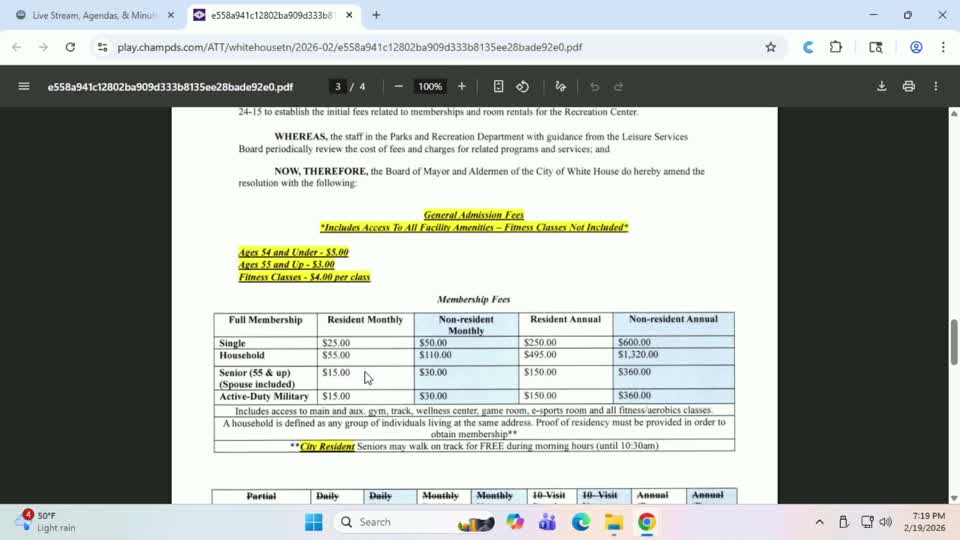
Parks and Recreation Director Kevin Whitaker proposed eliminating partial memberships (102 of 2,800 memberships, about 3.5%), replacing daily fees with a general admission fee, and clarified rules on service animals, smoking near children and vendor permissions; the board approved the fee changes and advanced municipal-code amendments for first reading.
Parks and Recreation Director Kevin Whitaker told the Board of Mayor and Aldermen that the city will eliminate partial memberships at the recreation center and replace daily fees with a single general admission charge, a change he said would simplify access control and reduce staff burdens.
Whitaker said the recreation center has about 2,800 memberships, of which 102 are partial memberships — roughly 3.5 percent — and proposed a phased approach to existing members (monthly partials prorated through April; annual partials allowed to expire). Under the new schedule he outlined, general admission would be $5 for people age 54 and under and $3 for people 55 and older; fitness classes would remain a $4 add-on.
The board discussed concerns about nonresident demand for court time (pickleball in particular) and asked staff to monitor usage and report back. Whitaker said outdoor amenities and additional park offerings should relieve some pressure on indoor court usage.
Whitaker also led a first reading of municipal-code amendments affecting the leisure services board. The proposed changes clarify that the secretary or director does not have voting authority, update picnic-area language (replacing references to fireplaces with grills), add limited exceptions for trained service animals consistent with ADA guidance, and narrow how smoking and vaping restriction zones are defined (areas where children are present, including playgrounds and aquatics areas). The update would also formalize an appeals process so that a committee, rather than a director, adjudicates suspensions from facilities or programs.
Board members asked about enforcement (who will ask the two ADA-permitted service-animal questions), signage for no-smoking areas, whether concessionaire contracts are exclusive and training for umpires and referees who may remove people from parks; staff said signage exists and indicated contract language or SOPs can clarify responsibilities.
Why this matters: The fee change removes multiple small membership classes to simplify operations and may affect nonresident users who previously paid different daily rates. The code amendments aim to reduce legal ambiguity on service animals, smoking zones and vendor permissions while preserving options for community events.
What’s next: The ordinance will return for a second reading after staff incorporates clarifications on contracts and enforcement; the fee schedule was approved by vote.