Get AI Briefings, Transcripts & Alerts on Local & National Government Meetings — Forever.
Bill would standardize procedures for intellectual-disability claims in capital cases; critics warn of tighter rules
Summary
A bill before the Criminal Justice Committee would create statutory procedures and evidentiary standards for intellectual-disability (Atkins) claims in death-penalty cases; supporters say it will speed resolution, while disability advocates and clinicians say proposed definitions and a rigid IQ cutoff risk misclassification and constitutional problems.
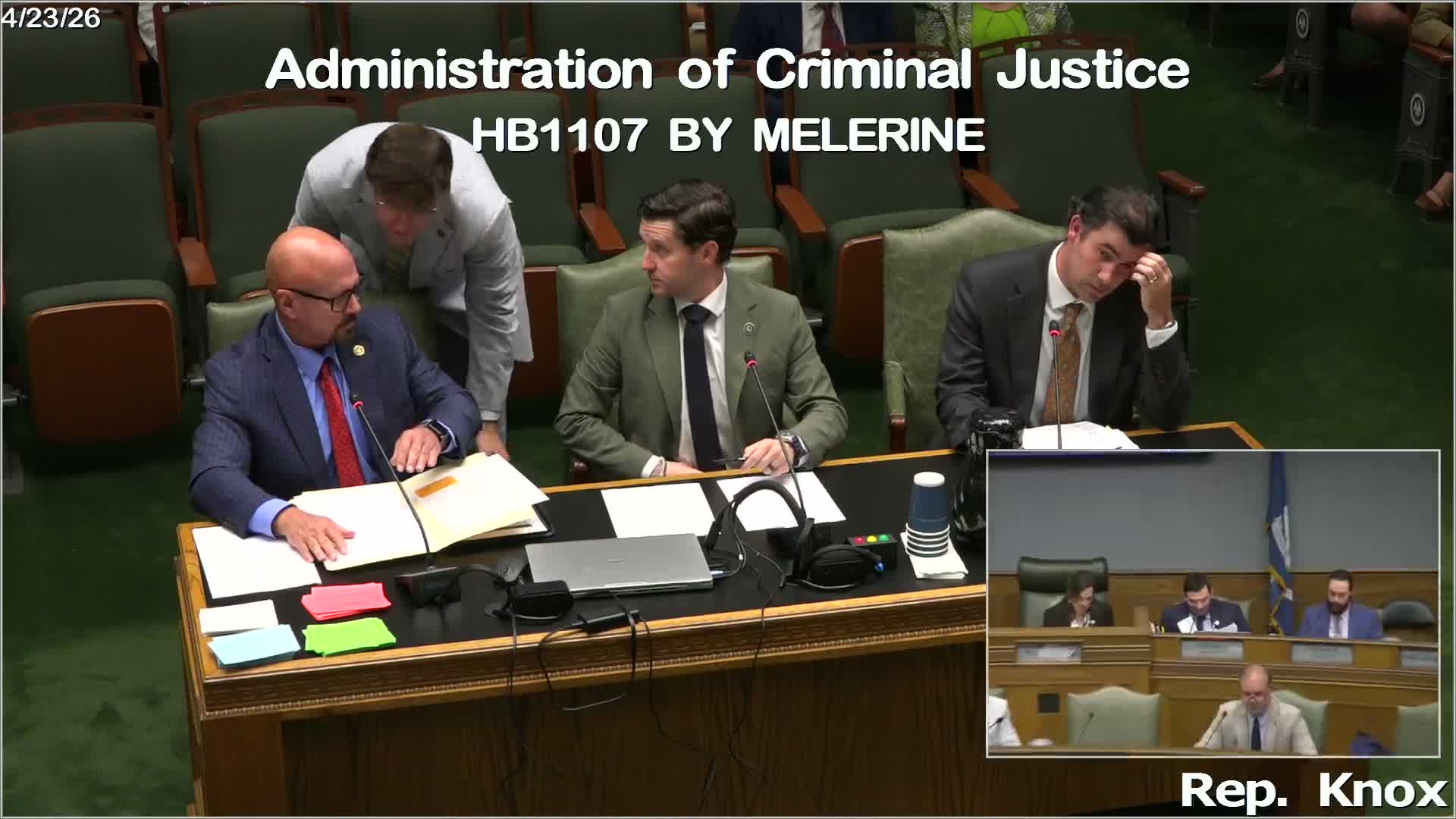
Representative Emilie Mellorin introduced House Bill 1107 to set out how intellectual-disability claims should be handled in capital and post-conviction proceedings, saying the change is needed to provide predictable rules and to prevent indefinite delays in high-stakes cases. "We want clear rules, reliable expert evidence and a gatekeeping function so only plausible claims go forward," Mellorin said during the Criminal Justice Committee hearing.
The bill, as amended, narrows its scope to death-penalty cases and raises the standard of proof in certain parts of the process. Larry Freeman, chief deputy attorney general, and Deputy Solicitor General Zach Faircloth told the committee that inconsistent procedures and an absence of a reliable post-conviction pathway have led to years-long delays in resolving claims. "We want the legislature to define the parameters so courts and litigants are on the same page," Faircloth said.
Supporters, including the Louisiana District Attorneys Association, said a clear statutory framework will bring predictability and help courts weed out unreliable claims earlier. "This creates train tracks for post-conviction death-penalty cases," said Zac Daniels of the District Attorneys Association, who argued the change will speed resolution for victims and defendants alike.
Opponents urged caution. Representatives of disability-rights groups and clinicians said multiple witnesses, adaptive behavior, and contemporary clinical standards must remain central; they warned that a single-test IQ cutoff and rigid presumptions would depart from accepted medical practice and could produce unconstitutional results. "Intellectual disability cannot be reduced to a single score," said Dr. Ashley Volion of Disability Rights Louisiana. Christine Lehman, a capital-defense practitioner, testified the proposed statutory language conflicts with clinical definitions and with prior U.S. Supreme Court guidance: "An IQ score alone can be misleading; the statute should preserve clinical judgment and the accepted DSM/AAIDD framework."
Committee members questioned how the bill accounts for ongoing federal litigation about multiple IQ scores and for the need to guard against unreliable expert reports. Faircloth said the measure explicitly allows courts to consider cumulative IQ scores and includes a gatekeeping step that would limit hearings to plausible claims. The amendments also direct courts to apply standards for admissible expert evidence and require certain procedural protections for report exchange and timing.
After extended testimony from clinicians, advocates and prosecutors, the committee adopted the amendment package and voted to report HB 1107 as amended. The committee minutes show the bill was reported favorably as amended.