Get Full Government Meeting Transcripts, Videos, & Alerts Forever!
Get email alerts on the Workforce topic
No spam. Unsubscribe anytime.
Board discusses staffing shortages, retention and rising demand for housing and behavioral‑health services
Summary
Human Services leaders told the Winnebago County board they have about a dozen open positions, are posting a third initial‑assessment supervisor to reduce caseloads, and have expanded housing specialists to five staff; housing specialists reported about 2,034 contacts from June–Feb (contacts, not unduplicated people).
Board members spent a substantial portion of the Feb. 23 meeting on recruitment, retention and operational pressures across child‑welfare, behavioral‑health and housing programs.
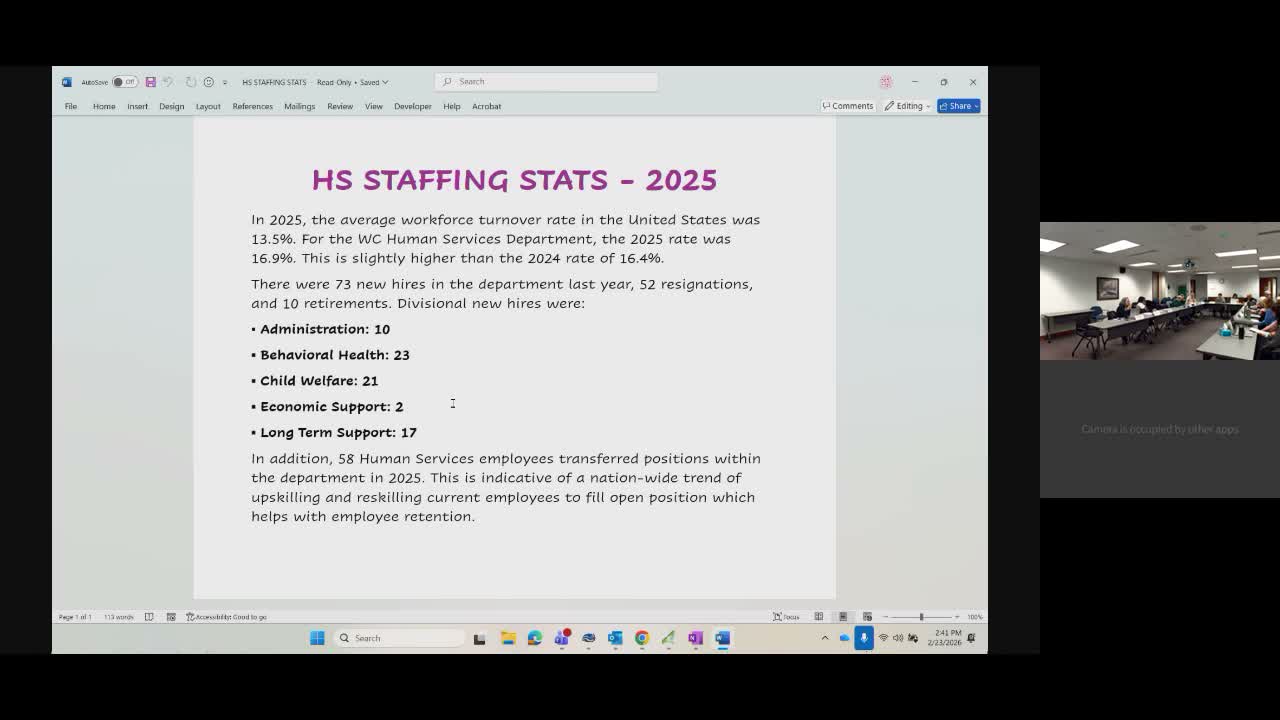
Presenter reported 12 open positions on the department career page (13 if the director position were included). The department recorded higher turnover than the national average last year (16.9% vs. 13.5% nationally), with 73 new hires, 52 resignations and 10 retirements in the previous year. Presenter said the department is repurposing positions and plans to post a third initial‑assessment supervisor to reduce caseloads (present caseload supervision was described as eight workers per supervisor, with a state average cited around five or six). "We're hoping to hire somebody soon," a staff member said.
Board members asked about the housing program, which Presenter said has grown rapidly: the department added its fifth housing specialist and now has five specialists plus one supervisor. Housing staff reported roughly 2,034 contacts (walk‑ins and calls) between June and early February; staff emphasized that figure represents contacts and not unduplicated individuals.
Board members and staff also discussed partnerships to reduce eviction risks; staff said the housing team already partners with the Winnebago County Conflict Resolution Center on eviction mediation. Presenter said some support comes from grants and donated funds, and that certain program expansions would likely require tax‑levy funding because grant eligibility or restrictions limit available funding in some cases.
The board discussed employee supports and training: the county provides an Employee Assistance Program (EAP) and divisions hold leadership and team events (some paid by supervisors or employee funds). The board also heard a success story from a permanency review in which a parent credited drug court for turning their life around and caseworkers celebrated a reunification outcome.
Board members asked for more granular service counts in future reports; staff agreed to supply additional breakdowns when possible.