Get Full Government Meeting Transcripts, Videos, & Alerts Forever!
Get email alerts on the Health And Human Services topic
No spam. Unsubscribe anytime.
Nevada County officials warn federal changes could strain health, human services budgets
Summary
Health and Human Services Director Ryan Groover told the County Board the agency is fiscally strong but faces major risks from federal reconciliation changes (HR1), including Medi‑Cal redeterminations, CalFresh work‑requirements and potential increases in indigent-care caseloads; Deer Creek Behavioral Health Center construction and homelessness reductions were highlighted as priorities.
Ryan Groover, director of Nevada County's Health and Human Services Agency, told the Board of Supervisors that the agency enters FY 2026–27 with stronger reserves and new revenue tools but faces substantial uncertainty from federal reconciliation legislation tracked as "HR1." Groover said the county is roughly 90% state and federal funded and is planning contingencies to limit the fiscal impact if eligibility rules change.
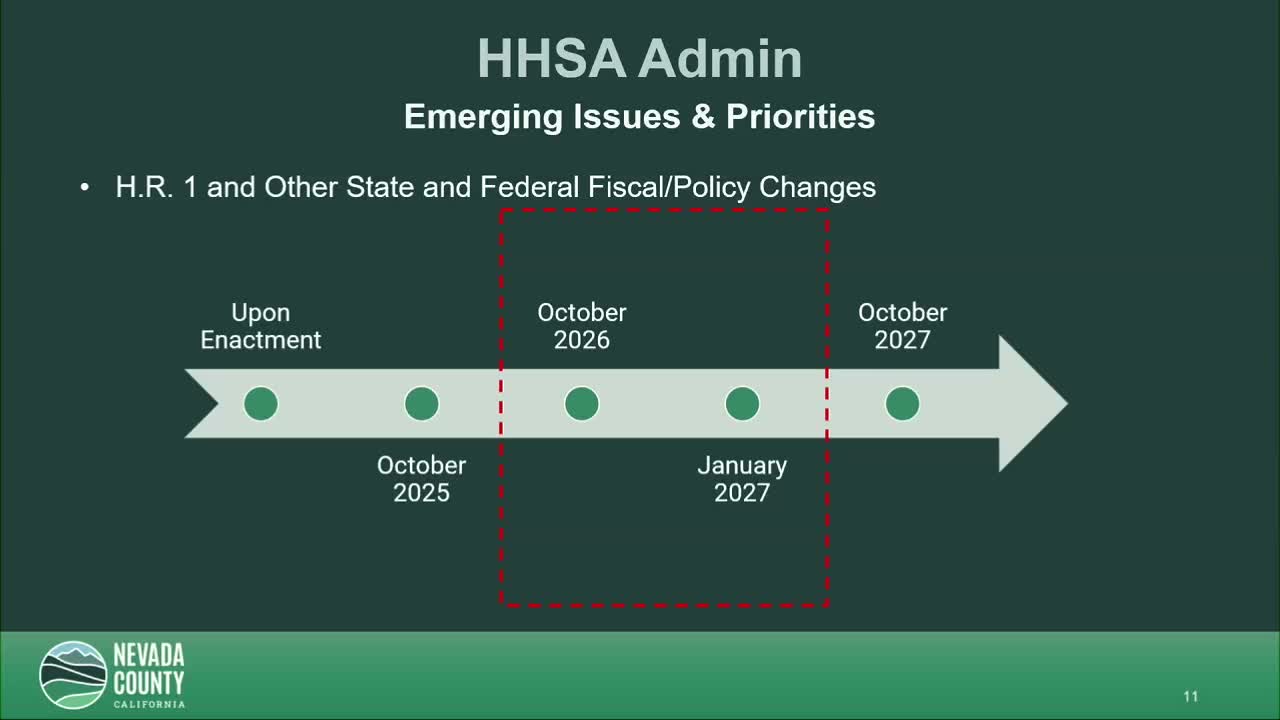
Groover said HR1 actions expected this year include tighter Medi‑Cal eligibility and a shift to six‑month redeterminations in January 2027, changes that could increase the number of uninsured residents. He also flagged added administrative costs for CalFresh that will begin in October and estimated a potential future state share‑of‑cost exposure that could reach millions of dollars.
The agency director emphasized the county's strategy to minimize disenrollment and cascading local costs: targeted use of realignment transfers, building Medi‑Cal administrative billing capacity, vacancy review, and partnerships with community organizations. Groover said the county will prioritize keeping people enrolled in Medi‑Cal because that reduces pressure on county-funded indigent care and local emergency services.
Groover described several ongoing investments he said increase resilience: the Deer Creek Behavioral Health Center construction (a capital project budgeted in 2026–27), expanded behavioral‑health services funded through payment reform, and housing partnerships such as the Regional Housing Authority'supported Lone Oak project. He credited those efforts with lowering the county's point‑in‑time homelessness count and said behavioral‑health bed expansion and supportive housing remain key tools for reducing unsheltered homelessness.
Board members pressed for specifics about who will carry new workloads if HR1 triggers a surge of uninsured residents. Groover said some needs could be met under the County Medical Services Program (CMSP) but cautioned CMSP's funding and capacity are uncertain and that counties without CMSP arrangements will face steeper local costs. He asked the board and county lobbyists to press the state and federal partners for aid to offset new workload and to protect critical partners such as victim‑services and community‑based organizations.
The agency will return to the board with specific proposals for realignment transfers, limited‑term staffing swaps to capture Medi‑Cal revenue, and a competitive one‑time grant program to help community organizations bridge immediate shortfalls caused by state and federal grant cuts. Groover said the department is also working to maximize behavioral‑health revenue that must legally be reinvested in the system.
The board directed agency staff to provide additional detail to the budget subcommittee and to keep supervisors informed as HR1 developments firm up.