Get Full Government Meeting Transcripts, Videos, & Alerts Forever!
Get email alerts on the Telecommunications topic
No spam. Unsubscribe anytime.
Nevada County adopts stricter cell-tower rules after hours of public comment
Summary
The Board of Supervisors voted unanimously April 14 to adopt amendments to the county's Communication Towers and Facilities Ordinance, adding larger setbacks, expanded notice, post-installation RF verification and maintenance requirements after months of outreach and a lengthy public hearing that drew dozens of callers and speakers.
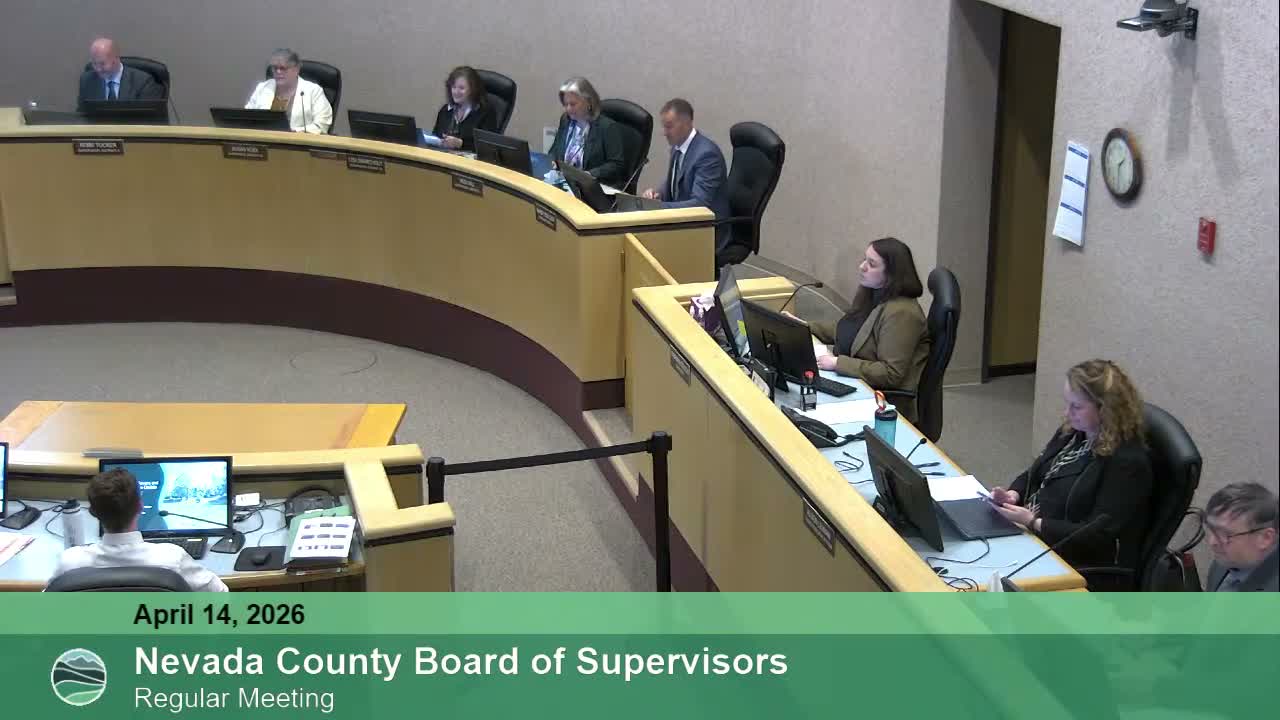
The Nevada County Board of Supervisors voted unanimously April 14 to adopt a package of amendments to the county's Communication Towers and Facilities Ordinance intended to strengthen neighborhood protections while preserving carriers' ability to expand broadband.
The ordinance increases notice requirements and application materials, adds post-installation radio-frequency verification and maintenance obligations, and ties siting and visual-impact standards to Federal Communications Commission definitions, planners said. The measure also raises setback requirements to a proportional 150% of tower height in many cases, a change staff said balances community compatibility and network feasibility.
"We updated the stated purposes and clarified definitions to align with the FCC," David Nicholas, associate planner, told the board during a detailed presentation of proposed edits. He said the changes require a broader alternative-site analysis, neighborhood notice within 1,000 feet before filing, and a facility maintenance agreement that obligates owners to remove sites within 12 months of abandonment.
The proposal drew extensive public comment, with residents urging greater protection for fire safety, clearer setbacks from homes and independent RF testing. "These sites must be reviewed and inspected for fire safety, both in their design and throughout their operation," said Louise Jones of the Lightning Tree Firewise Community, urging a detailed fire-safety plan for towers that house batteries, rectifiers and generators.
Telecommunications lawyers and industry representatives also spoke. Scott McCullough, who advised the Nevada County for Safe Tech group, said local governments can and should use setbacks and permitting to limit neighborhood impacts while complying with federal law. Verizon's municipal engagement partner, Jeremy Stroop, warned the board that overly large setbacks would effectively preclude tower development on many parcels and urged grandfathering for applications already in process.
Planning staff told supervisors they analyzed parcel availability under different setback scenarios and recommended a proportional approach that they said preserved enough parcels for feasible tower placement while increasing neighborhood buffers. Staff also said the amendments provide county authority to require testing "if good cause is presented" or if no RF compliance report is less than 12 months old.
The board debated applicability before voting. Under the adopted language, applications deemed complete before the ordinance's effective date will proceed under the previous rules; applications filed before April 14 but not deemed complete by the effective date must meet most new provisions except the proportional setback. The change was intended to avoid encouraging a rush of last-minute filings while extending many new protections.
The ordinance will take effect per standard timelines; supervisors asked staff to produce plain-language guidance for affected applicants and to ensure noticing methods are robust and verifiable. The board's adoption followed a unanimous Planning Commission recommendation and months of outreach and more than 98 unique public comments during the review process.
The board concluded the hearing by adopting the ordinance with the amended applicability language and a direction to include or clarify a fire-safety plan requirement as part of mitigation and approval conditions.
Next steps: staff will finalize ordinance language consistent with board direction and prepare outreach materials explaining the new notice and application requirements for prospective applicants and the public.