Get Full Government Meeting Transcripts, Videos, & Alerts Forever!
Get email alerts on the Floodplain Policy topic
No spam. Unsubscribe anytime.
Attorney urges adoption of DNR-model floodplain resolution; committee asks for legal review
Summary
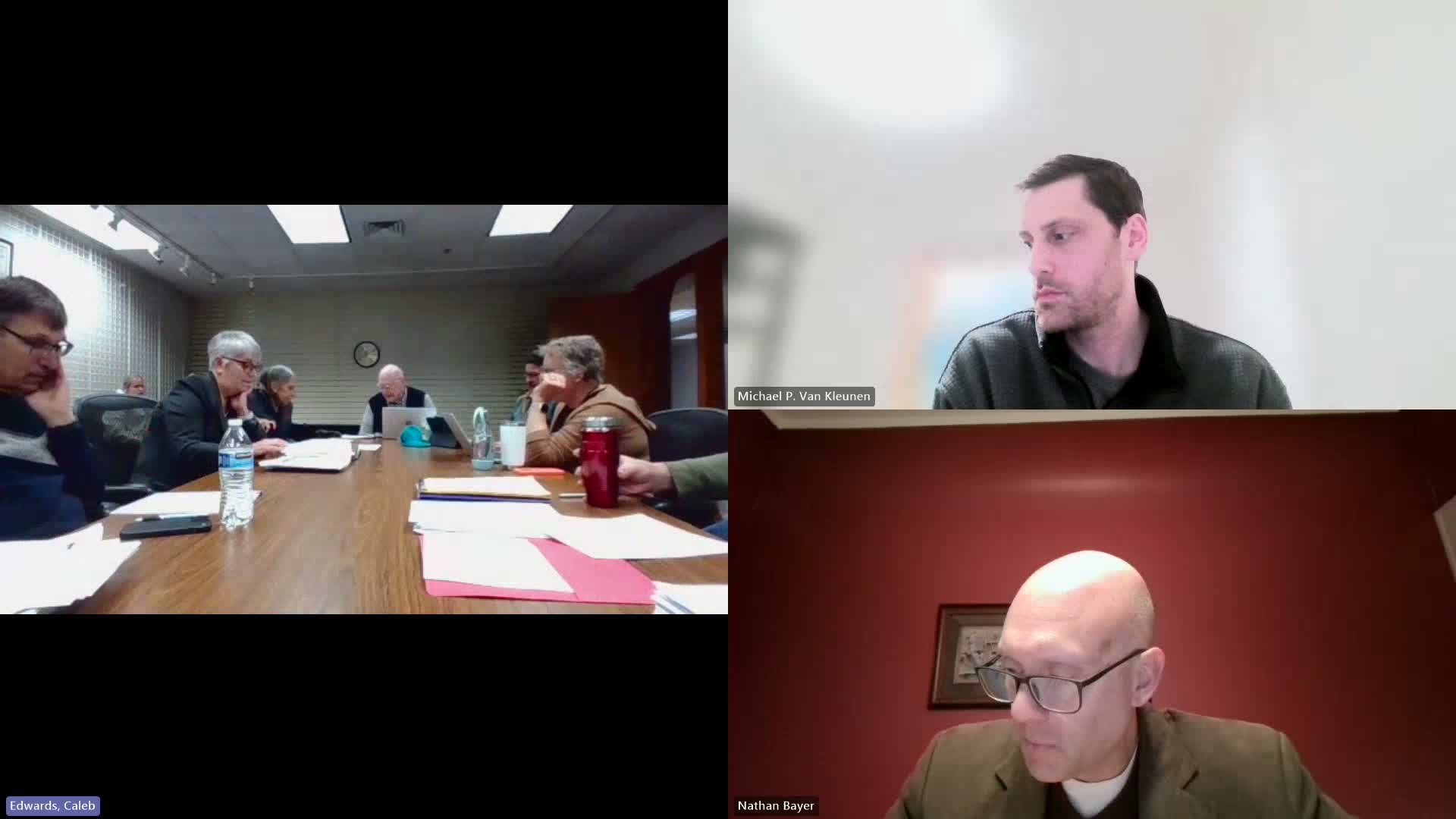
At a Winnebago County Planning & Zoning Committee meeting, attorney Michael Van Cloonen urged adoption of a floodplain resolution aligned with DNR model language to allow repairs and reconstruction of preexisting homes; committee members and staff debated the local 50% threshold, FEMA elevation standards and whether a resolution can change code, and asked attorneys to deliver written guidance by Jan. 23.
Chair (speaker 3) opened the committee’s discussion of a proposed floodplain resolution that the chair said corrects language from a prior meeting and would affect how preexisting shoreline and floodplain structures are handled.
Attorney Michael Van Cloonen (speaker 5), representing homeowners, urged the committee to approve a resolution that mirrors the Wisconsin Department of Natural Resources model ordinance and state law. "We are not engaging in any kind of new construction," Van Cloonen said, arguing the draft would allow owners of older, nonconforming homes to repair or reconstruct so long as work meets FEMA standards and the house is raised above the flood-protection elevation. He described staff statements at a previous meeting that characterized the project as new construction as "outright false."
A legally trained staff member (speaker 7) advised the committee that the DNR model and local ordinances do reference a 50% threshold distinguishing maintenance from repair, reconstruction or improvement. The advisor said 2019 Act 175 (often cited in the discussion) requires that locally authorized repair, reconstruction or improvement meet the federal standards in 42 U.S.C. § 4001 et seq. and be elevated above the flood-protection elevation if local policy is to permit activity above the 50% threshold. "The current 50% thresholds that are in your ordinances are absolutely consistent with the existing model ordinance," the staff member said, and warned that changing local policy without coordinating with federal standards could risk unintended consequences for federally backed flood insurance premiums.
Chair (speaker 3) said Winnebago County code (cited as Sec. 26.7-1) appears to exclude the cost of elevating the lowest floor to the flood-protection elevation from the 50% calculation, and asked the committee’s attorneys and staff to confirm whether the resolution is necessary. "I'm a property-rights guy," the chair said, describing his intent to balance owner rights with environmental and safety protections.
Committee members asked technical questions about required engineered plans and floodway certifications. Counsel and staff said engineered foundation designs and a floodway/floodproofing certification would be required to meet FEMA standards; meeting those standards was discussed as the practical path to allow reconstruction while preserving eligibility for insurance.
Rather than adopt the resolution at the meeting, the committee requested written guidance: the chair asked that attorneys and staff provide a written explanation to Mary Anne by Jan. 23 and circulate it to committee members in advance of the next planning and zoning meeting. The committee agreed to revisit the item at a later meeting and to consider whether code amendment (rather than a resolution) is the correct vehicle to make any change.
The committee did not take a final vote on the resolution at this meeting; members agreed on a process to get legal clarity and return the item for further action.