Get Full Government Meeting Transcripts, Videos, & Alerts Forever!
Get email alerts on the Public Health Outreach topic
No spam. Unsubscribe anytime.
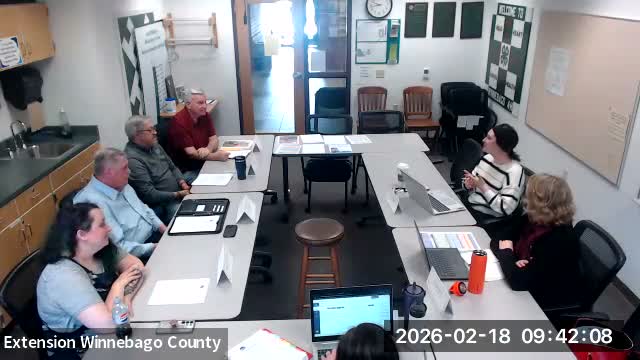
UW Extension highlights substance-use declines, recovery app and SNAP-related strain in Winnebago County
Summary
At a Winnebago County UW Extension oversight meeting, staff celebrated a national award for local prevention work and reported survey declines in teen substance use while warning that SNAP changes are straining local food services and spurring new coordination efforts.
Katie, the committee's health and well-being educator, told the oversight committee that the Breakwater Coalition received national recognition and that local prevention work has shown measurable improvements among students.
“We have seen only decreases in our substance use among high school students in Oshkosh,” Katie said, citing the coalition’s surveys of 2019–2023 trends and noting that the coalition presented its results to U.S. senators during recent advocacy visits in Washington, D.C. She said coalition members accepted a Major General Arthur T. Dean Chairman’s Award and brought local impact graphs to meetings with office staff for Sen. Baldwin and Sen. Johnson.
The report covered programming and outreach the extension runs and supports: Strong Bodies and ReCode classes, youth groups co‑facilitated at local schools and the Boys & Girls Club, block-party activities for young children, and multiple Mental Health First Aid sessions scheduled for county employees and partner organizations.
Katie also previewed a recovery-focused summit for March 4 at the UWO Culver Center with breakouts, tabling and national presenters, and described the regional resource app “We Heart You” as a searchable tool for mental-health and substance-use supports serving Winnebago and nearby counties.
Members asked whether extension staff could deliver outreach at a local tiny-house site where residents are in recovery. Katie said she has run coping-skills sessions there before and offered to contact site coordinators to explore further programming in the site's community room.
Separately, a committee member raised concerns about recent SNAP rule changes and whether counties might have to take on additional administrative work. Katie said extension is not administering SNAP benefits but is working with community partners to connect affected families to resources. She and other staff described food providers as still being in an “emergency response mode” because of increased demand, and said mapping and coordination among food-system partners is a current priority.
“We are trying to support them as best we can,” Katie said, describing efforts to provide staffing, research support and communications channels to help pantries and other providers manage surges in need.
The committee did not take formal action on SNAP-related policy but directed staff to continue coordination with county partners and to resume a planned community needs assessment and service-mapping work that had been paused during the recent SNAP-related disruptions.