Get Full Government Meeting Transcripts, Videos, & Alerts Forever!
Get email alerts on the Game Room Ordinance topic
No spam. Unsubscribe anytime.
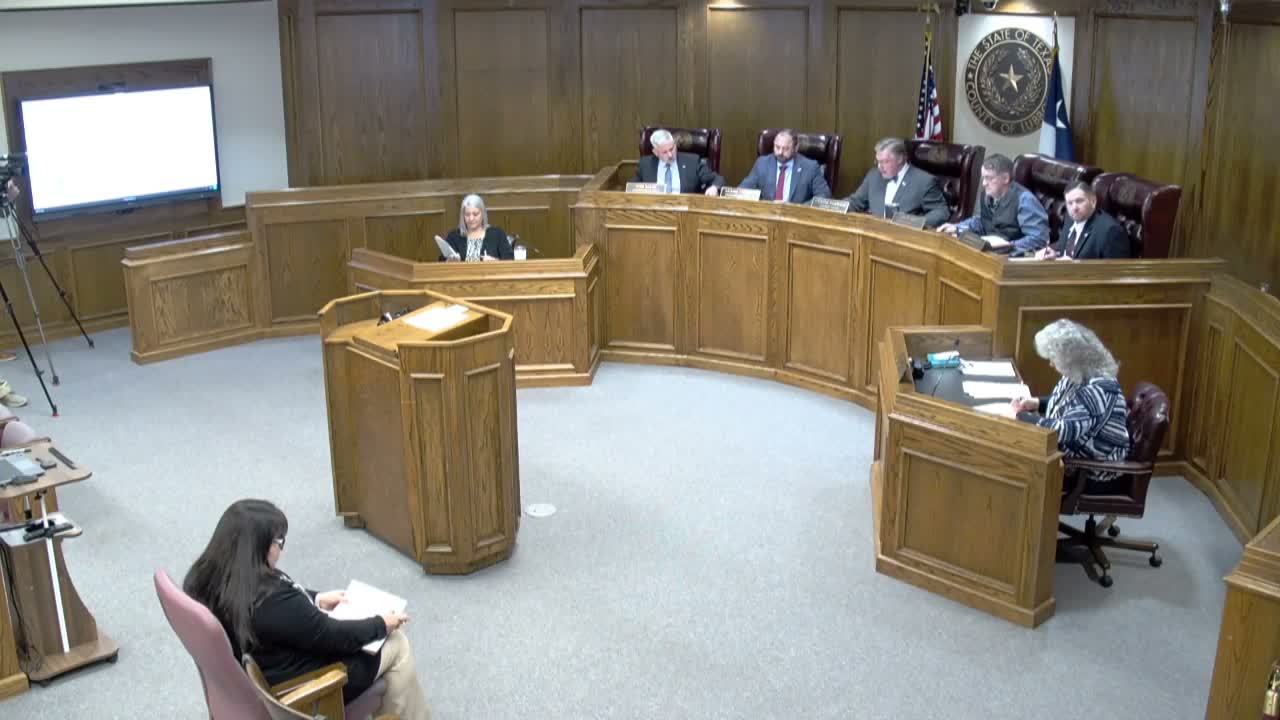
Lubbock County adopts tighter game room rules after yearlong review
Summary
After a year of enforcement, Lubbock County Commissioners Court approved amendments tightening permitting, enforcement and transparency requirements for game rooms, adding immediate revocation authority and criminal penalties while debating hours of operation and hearing procedures.
Lubbock County Commissioners Court on Feb. 23 adopted a package of amendments to the county’s game room ordinance aimed at clarifying permit rules, enforcement procedures and safety requirements after a year of implementation and review.
Neil Berg of the Lubbock County District Attorney’s civil division told the court the amendments respond to issues that arose during the ordinance’s first year, including ambiguous definitions, out-of-state owners applying remotely and enforcement gaps. “We just need to go ahead and have very clear rules that we enforce identically across the board,” Berg said.
Changes the court approved clarify the ordinance’s definition of premises, make game-room permits non-transferable (requiring reapplication on ownership change), require in-person applicant appearances and translators when needed, and add transparency requirements for doors and windows to assist law enforcement. The package also refines what constitutes violations, establishes immediate permit revocation for operation outside authorized hours or for specified breaches, and adds civil and criminal penalties for some offenses.
Commissioners debated civil-liability and safety tradeoffs before voting. Commissioner Dolby offered and won an amendment restricting hours of operation to local time between 8 a.m. and 5 p.m. Monday–Friday; the court removed a specific “Central Standard Time” label so the rule operates on local time year-round. Several commissioners expressed concern that the restriction is more limiting than comparable jurisdictions but accepted it as a public-safety measure.
The court also discussed the structure and timing of enforcement hearings. Berg said the amendments move away from single-judge hearings toward a citizen hearing panel model used in other county processes and would allow a pool of hearing officers to be appointed as needed to avoid scheduling delays. Commissioners pressed whether the county could assemble panels quickly enough to avoid legal exposure when permits are suspended; Berg said panels of three would be the practical quorum and staff would work to convene hearings as expeditiously as possible.
On security measures, the ordinance prohibits exterior security doors that block law-enforcement access during operating hours; county attorneys said the provision aims to balance business safety features with first-responder access. Commissioners raised concerns that prohibiting certain security doors might expose employees to risk; county counsel said those features can be preserved if they are not exterior doors that impede lawful access.
Judge Parrish said the amendments give county officials additional tools to address ongoing public-safety concerns around certain game-room operations and indicated the court will continue adjusting the ordinance as issues arise.
The motion to adopt the amendments, as amended, carried unanimously.