Get Full Government Meeting Transcripts, Videos, & Alerts Forever!
Get email alerts on the Transit Paratransit topic
No spam. Unsubscribe anytime.
Go Transit outlines paratransit rules, new red‑zone pilot connecting Oshkosh and Neenah
Summary
Go Transit staff described complementary paratransit requirements under the ADA, service area and fare rules, and a year‑long pilot (started April 1) using taxi rides to restore neighborhood connections formerly served by Route 10 between Oshkosh and Neenah.
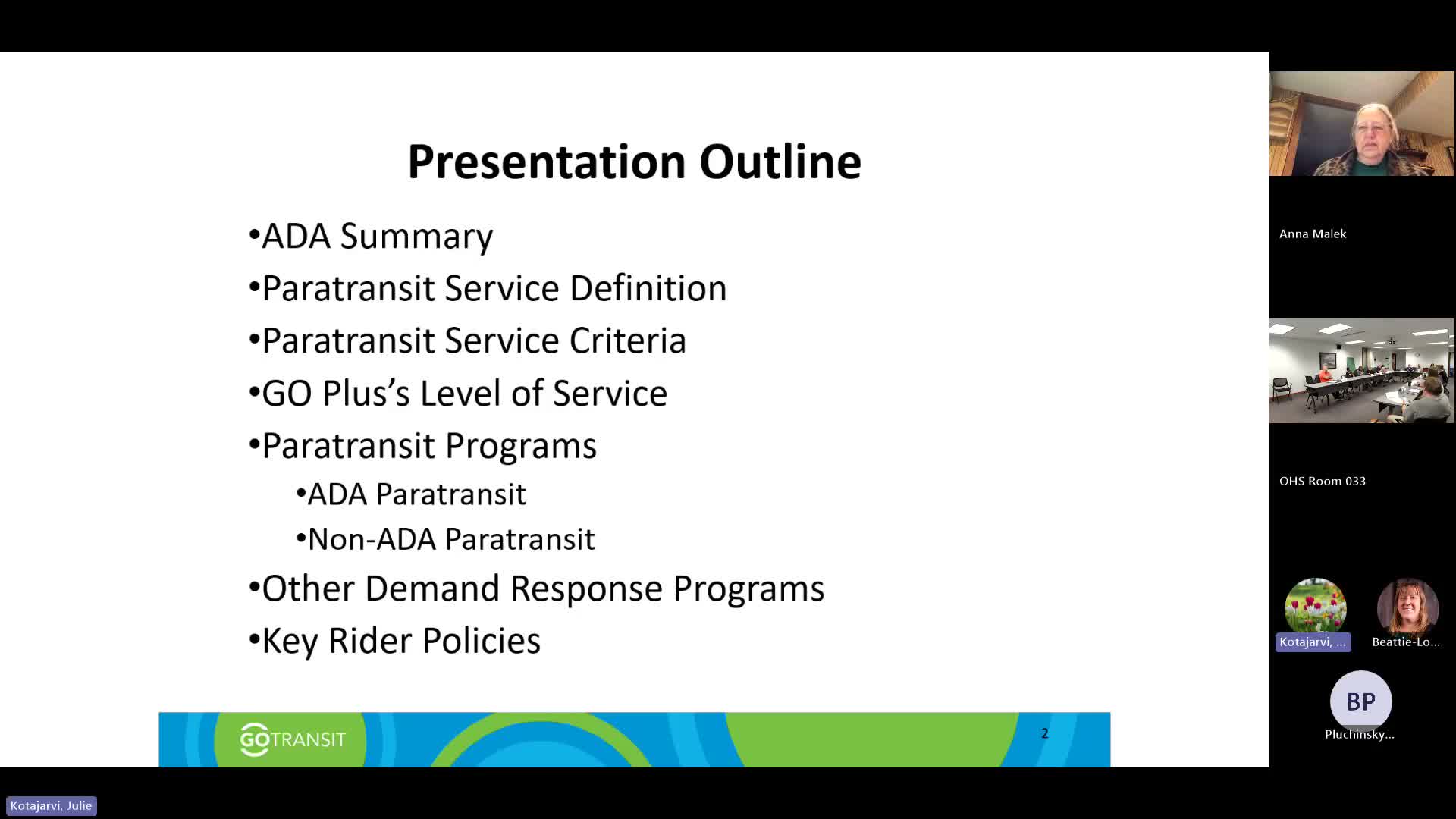
Jim Collins, introduced on the record as the city’s transportation director, gave the commission an overview of Go Transit’s paratransit program and a new one‑year pilot intended to restore former Route 10 connections between Oshkosh and Neenah.
Collins said complementary paratransit exists because the Americans with Disabilities Act and Federal Transit Administration rules require an equivalent service for riders who cannot use fixed‑route buses. He described the program as a shared‑ride service — often provided by sedans or minivans via a taxi contractor — meant to be comparable in hours and coverage to the fixed‑route bus, not medical transportation. Riders must generally be able to reach the curb (threshold service is available for an additional fee) and one personal care assistant rides free.
The city limits and funding determine the service area; Collins said the paratransit corridor is defined as three quarters of a mile around fixed routes and that hours are aligned with bus service. Current posted bus hours are about 6:15 a.m. to 6:45 p.m. Monday–Saturday; Go Plus (the paratransit brand) operates extended hours including early mornings and evenings. By regulation, paratransit fares cannot exceed twice the base bus fare; Collins said Go Transit charges $2 for the bus and $3 for paratransit. Paratransit rides require next‑day booking to allow for shared‑ride scheduling.
Collins reported the city’s current contract for paratransit service is with Oshkosh CityCab through the end of the year and that the city plans a request for proposals for future service. He said Go Transit provided nearly 25,000 paratransit rides in 2025 and that fewer than 10% of trips occur after standard service hours.
As a service expansion, Collins described a pilot that began April 1 to serve a “red‑zone” area previously covered by Route 10. The pilot uses taxi rides to bring riders to transfer points (including the North transfer point at the Edel Brook/Northpointe area), Sunnyview Expo Center and the Coughlin Center; in‑city connector rides are $2 while city‑to‑city trips are $5. Collins said ridership data will be monitored during the year to evaluate the pilot’s success.
Commission members asked practical questions about transfer points, how Valley Transit riders connect in Neenah, and whether the pilot covers destinations such as dialysis centers; Collins responded that riders can pay Valley Transit fares to reach Neenah’s transfer point and then use Go Transit’s connecting service, and that exceptions or additional county contributions may be discussed for specific destinations.
The presentation also covered operational details: pickup windows are ±15 minutes, repeated no‑shows can lead to suspension, and vehicles have wheelchair weight/size limits. Collins reiterated that drivers are not medical staff and that paratransit is publicly funded (federal/state grants plus city/county contributions). He encouraged commissioners and staff to use the transit website’s trip planner (GTFS/Google Transit feed) and to contact the office with questions.
The commission thanked Collins for the overview and complimented the senior dial‑a‑ride application improvements that allow remote enrollment.