Get Full Government Meeting Transcripts, Videos, & Alerts Forever!
Get email alerts on the Annual Report topic
No spam. Unsubscribe anytime.
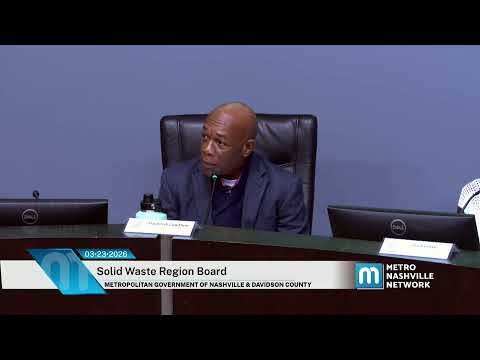
Solid Waste Board approves 2025 annual report and endorses $2.4 million EPA grant for MRF
Summary
The Solid Waste Board approved the 2025 Annual Report and solid waste management plan by voice vote after a staff presentation on recycling gains, pilot programs and an EPA grant to help develop a publicly owned materials recovery facility (MRF).
The Solid Waste Board voted to approve the 2025 annual report and solid waste management plan after a presentation summarizing diversion progress, pilot programs and funding priorities.
Jen Harmon, staff support for the Department of Waste Services, told the board the county saw a 2.75% increase in recycling collected from Metro and satellite-city programs and that municipal solid-waste landfilling decreased by 5.68%. Harmon said the department was awarded a $2,400,000 grant from the U.S. Environmental Protection Agency to help build a publicly owned, scalable materials recovery facility (MRF) intended to improve local processing and markets.
The report to the board emphasized infrastructure, market access and staffing as the key obstacles to greater diversion. Harmon said Metro has increased waste services staffing substantially over the past year (74 hires and 30 new positions added) and highlighted operational investments including a county-wide reroute of curbside service, new dispatching systems, vehicle pre/post-trip inspection technology and upgrades to convenience centers. She also described a donated foam densifier (to be installed at the East Convenience Center) and a continuing food-scraps pilot that has involved roughly 750 participating households and collected more than 474,000 pounds of material since its start.
Why it matters: the grant and proposed MRF aim to reduce the jurisdiction’s reliance on private processing contracts and volatile commodity markets, which staff said have produced high processing fees and limited local capability to recycle a wider range of materials.
Board discussion touched on how construction-and-demolition (C&D) materials have been counted in the diversion metrics and the need to finish a four-season waste characterization study (three seasons complete) to provide more accurate data for planning. Harmon noted initial numbers showing a drop in out-of-state tonnage (303,000 this year versus 375,000 last year) and a reported decline in C&D landfilling of about 16.78% in preliminary figures.
Questions from board members focused on how commodity revenues and processing fees affect net returns; staff said recent processing costs to Metro were about $150 per ton, above the industry average of $85–$95, and that revenue-sharing arrangements often eliminate net value in current contracts. Staff said the EPA grant will help pay for equipment such as balers, conveyors and AI/optical sorting technologies to increase local processing capability.
The board approved the annual report by voice vote. The chair said the next steps will include public procurement activity (staff noted the curbside and processing contract solicitation process is underway), follow-up reports as the waste-audit data are finalized, and continued coordination on grant-funded capital work.
At the meeting’s close, members approved routine minutes from an earlier meeting and adjourned.