Get AI Briefings, Transcripts & Alerts on Local & National Government Meetings — Forever.
Rep. Ursula Anderson pushes 100% tax on proceeds of public-program fraud in HF5040
Loading...
Summary
Representative Ursula Anderson presented House File 5040, the "Take It Back Act," which would impose a 100% tax on amounts fraudulently taken from Minnesota public programs; the Department of Revenue described how it would administer the tax and committee members raised questions about timing, priorities and the use of tips. The bill was laid over for possible inclusion in the omnibus tax bill.
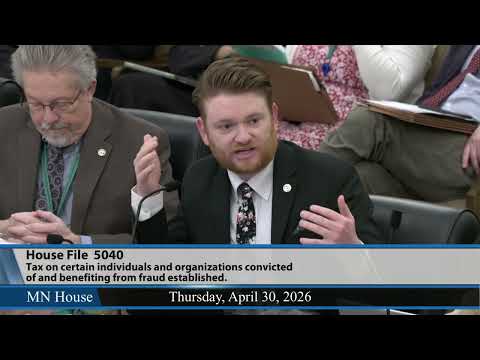
Representative Ursula Anderson introduced House File 5040, dubbed the "Take It Back Act," during a House committee session, saying the measure would require people convicted of defrauding Minnesota public programs to pay a 100% tax on the amount they stole. "If you are convicted of fraud ... defrauding our public programs in the state of Minnesota, you will have to pay 100% tax on those dollars," Anderson said during her presentation.
The bill, Anderson said, has broad, bipartisan sponsorship in both chambers and — she added — language in the DE1 amendment was developed in consultation with the Department of Revenue to ensure the agency could administer the penalty. "After we filed, we met with the Department of Revenue ... they were wonderful, and we worked together," Anderson said.
Joanna Bares, legislative director for the Minnesota Department of Revenue, described how the department would implement the proposal if it becomes law. "They would send it to us, and then we apply a 100% tax through a tax order or tax adjustment," Bares said, adding that the department also can assess penalties when program fraud is identified through audits, tips or interagency referrals.
Committee members pressed staff and the bill author on practical questions. Representative Hollins asked whether the tax would be faster or more effective than court-ordered restitution given typical administrative lags. "Is this actually more effective than, say, what the courts are doing in asking to pay restitution?" Hollins asked, noting past delays in tax collection. Anderson and Bares said the tax would be assessed in addition to restitution orders and that the department expects to be able to apply the tax promptly upon receiving a certified conviction amount.
Lawmakers also raised questions about where recovered funds would go. Hollins said the committee packet's letter arguing that recoveries should return to the specific program harmed was "very compelling." Bares said statutory lien priorities determine collections and that restitution would likely be collected first; the department's tax lien and any subsequent collections would follow statutory priority rules.
Concerns about reliance on tips also surfaced. Hollins asked whether a tip-driven process risked sending the department after unverified or bad-faith allegations. Bares replied the department already operates a tip line, receives referrals from other agencies under an executive order, and reviews tips as part of its existing fraud work, and said staff aim to evaluate tips before taking enforcement action.
Representative Smith sought to clarify scope: the extra 100% penalty "would only apply to public fund fraud," Bares confirmed, saying the department would apply the penalty only to the portion of fraud that involved public funds rather than to unrelated private-sector tax fraud.
Representative Witte praised the effort as another tool to address fraud, and Anderson closed by asking the committee to lay the bill over for possible inclusion in the omnibus tax bill. The chair agreed to lay the bill over for further consideration.
The committee heard technical administration details from the Department of Revenue and questions about timing, priority of collections, and safeguards against misuse of tips; the author and agency said the tax would be applied in addition to restitution and that existing interagency processes and the department's tip review would be used to identify cases.