Get AI Briefings, Transcripts & Alerts on Local & National Government Meetings — Forever.
Planning commissioners debate rezoning request and conditional-use permit near 7th and 13th streets
Loading...
Summary
The Benton City Planning Commission reviewed a request to rezone Lot 9 from R2 to R3 and a conditional-use permit for a 13th Street parcel, focusing on density (12 v. 20 units/acre), sewer and water capacity, and a temporary moratorium; commissioners directed staff to draft findings for later action.
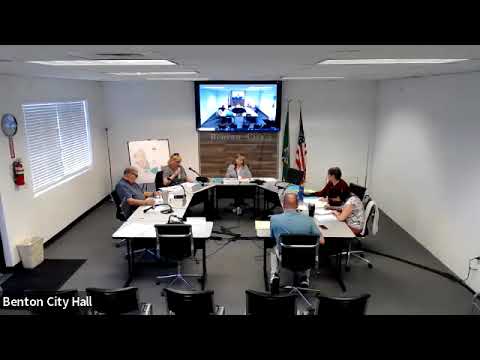
The Benton City Planning Commission spent a large portion of its meeting on a developer’s request to change land-use rules affecting two parcels near 7th and 13th streets, debating density, infrastructure and how a city moratorium affects the commission’s recommendation.
Staff told commissioners the rezone application involves Lot 9, roughly 2.3 acres, with the R3 designation allowing a maximum of 20 units per acre while the R2 designation allows about 12 units per acre. The difference, commissioners said, could materially change the number of housing units and the character of the neighborhood.
“ My recommendation to this council would be to leave it at R2,” said Darryl Heinberger, a resident at 900 East 7th Street, during public comment, urging the commission to preserve the existing neighborhood character.
Staff framed the procedural choices and constraints: a full rezone to R3 would raise density, while the applicant had instead sought a conditional-use permit (CUP) on a second parcel off 13th Street that would keep the underlying R2 density but allow units to be clustered. Staff warned that any CUP would need to be conditioned on the council lifting a moratorium that affects how multifamily uses in R2 are interpreted, and on confirmation that water and sewer infrastructure could accommodate additional units. “ If this body decide to grant the conditional permit, it would need to be conditioned on lifting of the moratorium, which the applicant … is aware of,” staff said.
Commissioners repeatedly pressed on infrastructure: water extensions, sewer capacity and the potential need for upsized lines or a lift station. Staff said those costs and engineering requirements are the developer’s responsibility and noted that some parts of town already experience sewer backups. “The developer has to pay for their impacts,” staff said.
During discussion a commissioner moved to deny the rezone based on comprehensive-plan consistency; the commission then discussed drafting specific findings of fact to support a recommendation to the council. Commissioners directed staff to prepare amended findings for the commission’s review and signature so the record would reflect the commission’s reasoning when the matter goes to the city council. The transcript does not record a completed roll-call vote on the rezone request.
Commissioners also debated broader policy changes, including pending state rules on accessory dwelling units and city-level design guidance, saying local code changes should accompany new state requirements so neighborhoods retain design standards and to reduce conflicts between state law and local preferences.
Next steps: staff will draft findings of fact based on the commission’s direction and return them for commission sign-off. The planning commission’s recommendation and the staff record will go to the city council, which staff said is expected to consider lifting the moratorium before council action on the matter.