Get Full Government Meeting Transcripts, Videos, & Alerts Forever!
Get email alerts on the Municipal Budget Cip topic
No spam. Unsubscribe anytime.
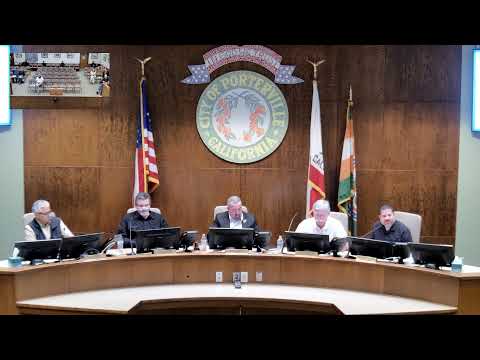
Porterville reviews $106 million draft CIP; council signals ‘great pivot’ to Newcomb Bridge
Summary
City Manager Rich Tree presented the draft FY 26–27 Capital Improvement Program, outlining roughly $106 million in planned projects and a 10‑year investment outlook; council debated shifting funding from an Olive Bridge widening toward the Newcomb Bridge and other inner‑city connector projects amid a roughly $28 million reimbursement shortfall.
City Manager Rich Tree presented the city’s draft fiscal‑year 2026–27 Capital Improvement Program to the Porterville City Council on Tuesday, describing it as a 10‑year investment plan for streets, water, parks and public safety. “Tonight, I’m presenting the city’s capital improvement program, which outlines our long term investment strategy over the next 10 years,” Tree said.
The draft program lists about $106,000,000 in projects for the coming fiscal year and shows multi‑year commitments across seven categories, including bridges and streets, water and wastewater, parks and public spaces, police and fire, transportation and miscellaneous facility work. Tree told the council the city completed roughly $83,400,000 in projects this past year and has identified about $1.1–$1.2 billion in planned projects over the last 10 years as part of a sustained investment program.
Why it matters: Councilmembers framed the CIP as both a planning tool and a ledger of promises the city must be able to deliver. Tree warned of funding constraints in some funds and said roughly $28,000,000 in reimbursements for previously completed work remains outstanding while staff processes claims with regional partners.
What council debated: A central debate focused on how to prioritize limited locally controlled funds. Several members, led by Mayor Meister and Vice Mayor McCurvey, called for a “great pivot” away from further investment in widening the county‑owned Olive Bridge toward building the Newcomb Bridge and associated connector roads and frontage improvements that staff and some council members argued would spur economic growth and relieve central congestion. Tree said staff can re‑program priorities if council directs it.
Councilmembers and staff also discussed a range of near‑term highlights in the draft CIP: construction of the Main Street parking lot (bids expected soon), continuation of 30 lane‑miles of self‑performed street maintenance, pedestrian safety projects (HAWK crossings and rapid‑flashing beacons moving into construction), continuation of the Del Oro and Hope water consolidations, design and construction work for Well 34 and Well 37, restart of library design, and final phases of the Overland Park Recreation Center and Veterans Park trail.
Public safety and utilities: The CIP includes upgrades to public‑safety radio repeaters and encryption, airport improvements, wastewater plant equipment and denitrification planning. Police Chief said the encryption component is a minority portion of a roughly $1M project (encryption ~ $200,000) intended to address dead zones. Water and wastewater staff described SCADA upgrades, reservoir rehabilitation, and wastewater generator needs; staff also flagged future compliance work tied to nitrate control and noted consultants will present options.
Budget context and next steps: Tree said some funds (sewer operating, water replacement) remain healthy while others are constrained, and that the CIP is a draft to be adopted with the budget. The council did not take formal votes on CIP priorities at the meeting; Tree said staff will bring revisions and that the city will present its preliminary budget at a special council meeting May 12. Several members urged staff to prioritize “shovel‑ready” projects to improve chances for state and federal funding.
Public comments: Members of the public praised the transparency of the presentation, urged attention to air quality and long‑range planning for the SOTU master plan, and suggested locating public amenities downtown to support revitalization.
The council directed staff to take the discussion into account and to return with any recommended re‑programming for the FY 26–27 CIP; adoption will occur with the budget process later this spring.